瘦 (shòu) means "thin; lean; slim" in Chinese. It has 14 strokes with the radical 疒, and is HSK Level 5.
Rated 4.2/5 in difficulty (advanced).
Harder than 82% of HSK Level 5 characters.
Appears in 3+ common words including 变瘦 (biàn shòu), 瘦肉 (shòu ròu), 瘦子 (shòu zi).
Due to its 14 strokes, Hanzi Writer's error detection shows 瘦 requires focused practice — most learners need 10+ attempts for consistent accuracy.
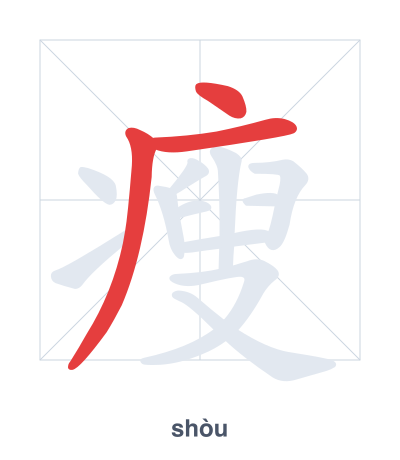
Open Hanzi Writer to see the animated stroke order and practice writing 瘦 with real-time feedback.
The character 瘦 (shòu) is written with 14 strokes. Follow the standard Chinese stroke order: top to bottom, left to right, outside before inside. The radical 疒 is one of its key components.
Practice the correct stroke order with the Hanzi Writer app to see animated stroke-by-stroke guidance with real-time feedback.
瘦 means thin; lean; slim.
As an HSK Level 5 character, 瘦 is an intermediate-level character.
The character 瘦 combines the radical 疒 (illness) with the phonetic component 叟 (old man). Illness often causes weight loss, and the image of an old man suggests frailty and thinness. Together, they depict being thin due to sickness or age.
💡 Memory Tip: Picture a sick old man (叟) lying in a hospital bed (疒), so thin you can see his ribs.
你最近变瘦了很多。
nǐ zuì jìn biàn shòu le hěn duō
You've lost a lot of weight lately.
我喜欢吃瘦肉。
wǒ xǐ huān chī shòu ròu
I like eating lean meat.
他是一个高个子瘦子。
tā shì yí gè gāo gè zi shòu zi
He is a tall and thin person.
Open Hanzi Writer to see the animated stroke order and practice writing 瘦 with real-time feedback.
✨ Animated stroke order · Handwriting recognition · HSK-graded practice · Free to use
The left side is the radical 疒 (sickness), which often indicates illness-related meanings. The right side is 叟 (old man), which gives the pronunciation. Together they suggest that being very thin can be a result of illness or aging.