僦 (jiù) means "to rent; to hire" in Chinese. It has 14 strokes with the radical 亻.
Rated 3.9/5 in difficulty (challenging).
Appears in 3+ common words including 僦居 (jiù jū), 僦屋 (jiù wū), 僦运 (jiù yùn).
Due to its 14 strokes, Hanzi Writer's error detection shows 僦 requires focused practice — most learners need 10+ attempts for consistent accuracy.
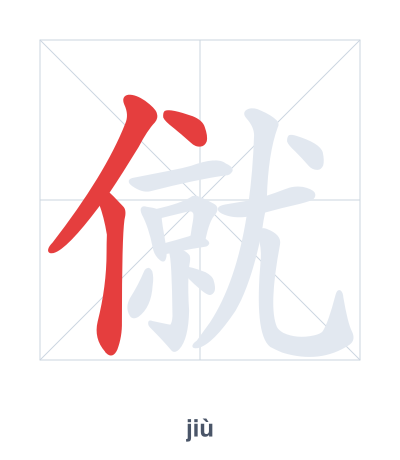
Open Hanzi Writer to see the animated stroke order and practice writing 僦 with real-time feedback.
The character 僦 (jiù) is written with 14 strokes. Follow the standard Chinese stroke order: top to bottom, left to right, outside before inside. The radical 亻 is one of its key components.
Practice the correct stroke order with the Hanzi Writer app to see animated stroke-by-stroke guidance with real-time feedback.
僦 means to rent; to hire.
This character combines the person radical 亻 with 就 (jiù, 'to accomplish' or 'to approach'), indicating a person who arranges or goes to hire or rent something.
💡 Memory Tip: Imagine a person (亻) who rents a costume saying, 'I just (就) need it for one night!'
他在上海僦居。
tā zài shàng hǎi jiù jū
He lives in a rented house in Shanghai.
我们去城里僦屋。
wǒ men qù chéng lǐ jiù wū
Let's go to the city to rent a house.
货物正在僦运中。
huò wù zhèng zài jiù yùn zhōng
The goods are currently being transported.
Open Hanzi Writer to see the animated stroke order and practice writing 僦 with real-time feedback.
✨ Animated stroke order · Handwriting recognition · HSK-graded practice · Free to use
僦 is composed of the radical 亻 (person) on the left, and 就 on the right. The left side indicates that the action is done by a person, while 就 (meaning 'to accomplish') hints at the result of hiring someone to complete a task. Together, they suggest a person hiring or renting something to achieve a goal.