僖 (xī) means "cautious; merry; joyful" in Chinese. It has 14 strokes with the radical 亻.
Rated 3.9/5 in difficulty (challenging).
Appears in 3+ common words including 僖乐 (xī lè), 恭僖 (gōng xī), 僖事 (xī shì).
Due to its 14 strokes, Hanzi Writer's error detection shows 僖 requires focused practice — most learners need 10+ attempts for consistent accuracy.
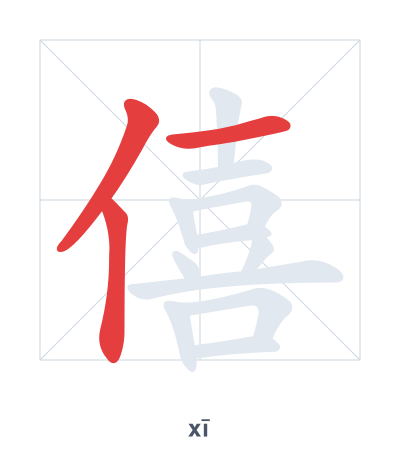
Open Hanzi Writer to see the animated stroke order and practice writing 僖 with real-time feedback.
The character 僖 (xī) is written with 14 strokes. Follow the standard Chinese stroke order: top to bottom, left to right, outside before inside. The radical 亻 is one of its key components.
Practice the correct stroke order with the Hanzi Writer app to see animated stroke-by-stroke guidance with real-time feedback.
僖 means cautious; merry; joyful.
僖 combines the radical 亻 (person) with 喜 (joy), where 喜 shows a drum (壴) and a mouth (口) representing cheering. Together, they depict a person full of joy or one who is cautiously merry, reflecting the character's dual meanings of caution and joyfulness.
💡 Memory Tip: Imagine a cautious person (亻) holding a drum (壴) and a smiling mouth (口) to celebrate joyfully without making too much noise.
他感到非常僖乐。
tā gǎn dào fēi cháng xī lè
He feels very joyful.
祝大家新春恭僖。
zhù dà jiā xīn chūn gōng xī
Happy Chinese New Year to everyone.
家里办了一场僖事。
jiā lǐ bàn le yī cháng xī shì
A happy event was held at home.
Open Hanzi Writer to see the animated stroke order and practice writing 僖 with real-time feedback.
✨ Animated stroke order · Handwriting recognition · HSK-graded practice · Free to use
僖 is made of the person radical 亻 on the left and the character 喜 (meaning happiness) on the right. Together, they suggest a person experiencing joy, which matches the meaning "merry" and "joyful." The radical 亻 indicates human emotion or action, while 喜 provides the sound and sense of happiness.