宾 (bīn) means "Guest / Visitor" in Chinese. It has 10 strokes with the radical 宀, and is HSK Level 5.
Rated 4.2/5 in difficulty (advanced).
Harder than 63% of HSK Level 5 characters.
Appears in 3+ common words including 宾馆 (bīn guǎn), 嘉宾 (jiā bīn), 贵宾 (guì bīn).
Due to its 10 strokes, Hanzi Writer's error detection shows 宾 requires focused practice — most learners need 10+ attempts for consistent accuracy.
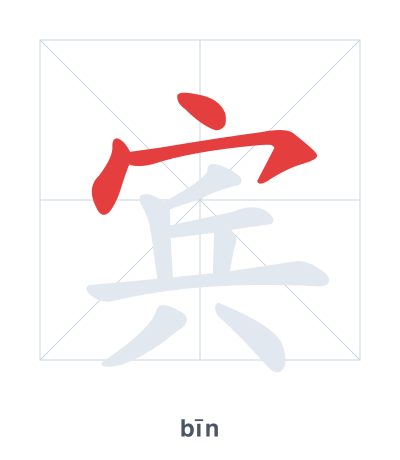
Open Hanzi Writer to see the animated stroke order and practice writing 宾 with real-time feedback.
The character 宾 (bīn) is written with 10 strokes. Follow the standard Chinese stroke order: top to bottom, left to right, outside before inside. The radical 宀 is one of its key components.
Practice the correct stroke order with the Hanzi Writer app to see animated stroke-by-stroke guidance with real-time feedback.
宾 means Guest / Visitor.
As an HSK Level 5 character, 宾 is an intermediate-level character.
The character 宾 originally depicted a person (人) with feet (止) arriving under a roof (宀), symbolizing a guest coming to stay. The modern form retains the roof and adds 兵 (soldier) as a phonetic element, though the historical sense of a visitor remains.
💡 Memory Tip: Imagine a soldier (兵) under a roof (宀) politely bowing as a guest, setting aside his weapon at the door.
宾馆就在前面。
bīn guǎn jiù zài qián miàn
The hotel is just ahead.
欢迎各位嘉宾。
huān yíng gè wèi jiā bīn
Welcome, distinguished guests.
他是这里的贵宾。
tā shì zhè lǐ de guì bīn
He is a VIP here.
Open Hanzi Writer to see the animated stroke order and practice writing 宾 with real-time feedback.
✨ Animated stroke order · Handwriting recognition · HSK-graded practice · Free to use
宾 is made of the radical 宀 (roof) on top and 兵 (soldier) below. The roof suggests a building, and a soldier or visitor under that roof gives the idea of a guest. This combination shows a person staying in a place they do not own.