疔 (dīng) means "Furuncle; boil; carbuncle" in Chinese. It has 7 strokes with the radical 疒.
Rated 3.5/5 in difficulty (challenging).
Appears in 3+ common words including 疔疮 (dīng chuāng), 疔毒 (dīng dú), 蛇疔 (shé dīng).
Due to its 7 strokes, Hanzi Writer's error detection shows 疔 requires focused practice — most learners need 10+ attempts for consistent accuracy.
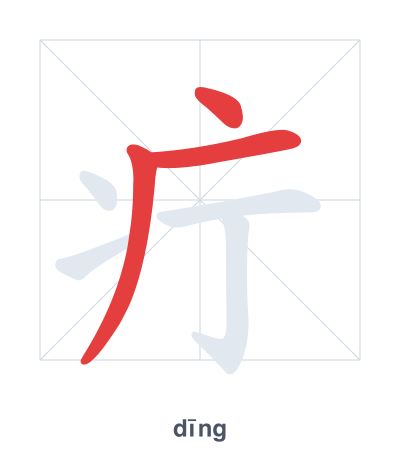
Open Hanzi Writer to see the animated stroke order and practice writing 疔 with real-time feedback.
The character 疔 (dīng) is written with 7 strokes. Follow the standard Chinese stroke order: top to bottom, left to right, outside before inside. The radical 疒 is one of its key components.
Practice the correct stroke order with the Hanzi Writer app to see animated stroke-by-stroke guidance with real-time feedback.
疔 means Furuncle; boil; carbuncle.
疔 combines the sickness radical 疒 with 丁 (dīng, 'nail'), suggesting a painful skin lesion that feels like a nail poking into the flesh. The character indicates a small, hard, inflamed swelling resembling a nailhead.
💡 Memory Tip: Imagine a nail (丁) piercing through the skin, causing an angry red boil (疒) that throbs with pain.
他长了一个疔疮。
tā zhǎng le yí gè dīng chuāng
He has a boil.
这种疔毒很厉害。
zhè zhǒng dīng dú hěn lì hài
This boil is very severe.
蛇疔需要快点治。
shé dīng xū yào kuài diǎn zhì
Whitlow needs to be treated quickly.
Open Hanzi Writer to see the animated stroke order and practice writing 疔 with real-time feedback.
✨ Animated stroke order · Handwriting recognition · HSK-graded practice · Free to use
疔 combines the radical 疒 (sickness) on the outside and 丁 (dīng, nail) as a phonetic and meaning component inside. The radical 疒 indicates that this character relates to illness or skin disease, while 丁 suggests the boil is hard and pointed like a nail.