疙 (gē) means "Lump; knot" in Chinese. It has 8 strokes with the radical 疒.
Rated 3.7/5 in difficulty (challenging).
Appears in 3+ common words including 疙瘩 (gē da), 疙疙瘩瘩 (gē gē dā dá), 心疙瘩 (xīn gē da).
Due to its 8 strokes, Hanzi Writer's error detection shows 疙 requires focused practice — most learners need 10+ attempts for consistent accuracy.
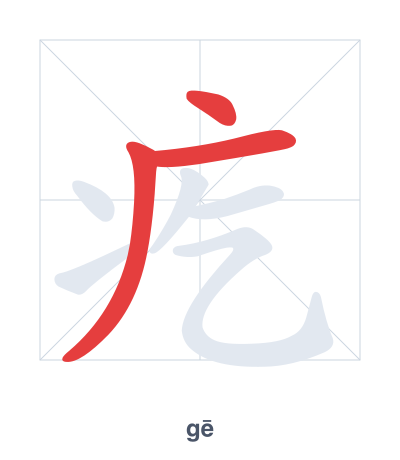
Open Hanzi Writer to see the animated stroke order and practice writing 疙 with real-time feedback.
The character 疙 (gē) is written with 8 strokes. Follow the standard Chinese stroke order: top to bottom, left to right, outside before inside. The radical 疒 is one of its key components.
Practice the correct stroke order with the Hanzi Writer app to see animated stroke-by-stroke guidance with real-time feedback.
疙 means Lump; knot.
This character is a phono-semantic compound: the radical 疒 (illness) suggests a skin condition, while 乞 (gē) provides the pronunciation. Together they depict a lump or knot that appears on the body.
💡 Memory Tip: Picture a sick person (疒) with a painful lump on their head, begging (乞) for relief.
我身上长了红疙瘩。
wǒ shēn shàng zhǎng le hóng gē da
I have red bumps on my body.
这条路疙疙瘩瘩的。
zhè tiáo lù gē gē dā dá de
This road is bumpy.
他解开了心里的疙瘩。
tā jiě kāi le xīn lǐ de gē da
He resolved the knot in his heart.
Open Hanzi Writer to see the animated stroke order and practice writing 疙 with real-time feedback.
✨ Animated stroke order · Handwriting recognition · HSK-graded practice · Free to use
The character 疙 is made of two parts: the radical 疒 (illness) on the left and 乞 (qǐ, beg) on the right. The radical 疒 connects the character to skin problems or sickness, and the phonetic component 乞 gives a hint for the pronunciation gē. Together, they suggest a lump or knot that appears on the body due to illness.