怨 (yuàn) means "resentment; to blame" in Chinese. It has 9 strokes with the radical 心, and is HSK Level 5.
Rated 4/5 in difficulty (challenging).
Harder than 48% of HSK Level 5 characters.
Appears in 3+ common words including 抱怨 (bào yuàn), 怨恨 (yuàn hèn), 怨言 (yuàn yán).
Due to its 9 strokes, Hanzi Writer's error detection shows 怨 requires focused practice — most learners need 10+ attempts for consistent accuracy.
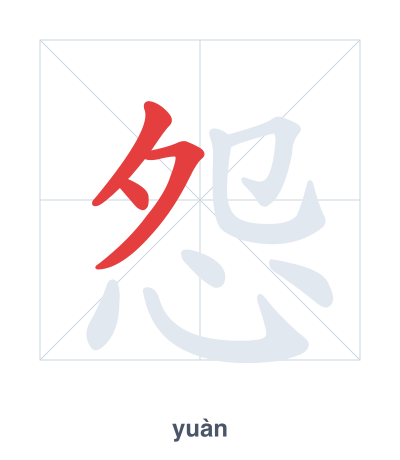
Open Hanzi Writer to see the animated stroke order and practice writing 怨 with real-time feedback.
The character 怨 (yuàn) is written with 9 strokes. Follow the standard Chinese stroke order: top to bottom, left to right, outside before inside. The radical 心 is one of its key components.
Practice the correct stroke order with the Hanzi Writer app to see animated stroke-by-stroke guidance with real-time feedback.
怨 means resentment; to blame.
As an HSK Level 5 character, 怨 is an intermediate-level character.
怨 combines 夗 (wǎn), a component suggesting twisting or bending, with 心 (heart radical), indicating emotions. The ancient form depicted a twisted heart, symbolizing the internal turmoil of resentment or blame.
💡 Memory Tip: Imagine a heart (心) twisted into a knot (夗) because it's full of resentment.
他总是抱怨天气不好。
tā zǒng shì bào yuàn tiān qì bù hǎo
He is always complaining about the bad weather.
别对他有怨恨。
bié duì tā yǒu yuàn hèn
Don't hold a grudge against him.
大家都没有怨言。
dà jiā dōu méi yǒu yuàn yán
No one had any complaints.
Open Hanzi Writer to see the animated stroke order and practice writing 怨 with real-time feedback.
✨ Animated stroke order · Handwriting recognition · HSK-graded practice · Free to use
怨 is composed of the radical 心 (heart/mind) on the bottom, and the phonetic component 夗 on top. The heart radical suggests emotions or feelings, while 夗 hints at the pronunciation yuàn. Together, the character conveys a feeling of resentment or blame that comes from the heart.