疝 (shàn) means "Hernia" in Chinese. It has 8 strokes with the radical 疒.
Rated 3.7/5 in difficulty (challenging).
Appears in 3+ common words including 疝气 (shàn qì), 疝带 (shàn dài), 疝痛 (shàn tòng).
Due to its 8 strokes, Hanzi Writer's error detection shows 疝 requires focused practice — most learners need 10+ attempts for consistent accuracy.
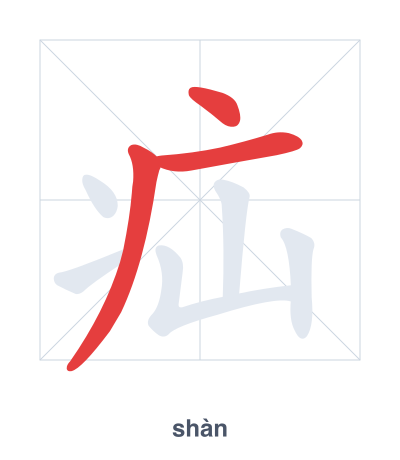
Open Hanzi Writer to see the animated stroke order and practice writing 疝 with real-time feedback.
The character 疝 (shàn) is written with 8 strokes. Follow the standard Chinese stroke order: top to bottom, left to right, outside before inside. The radical 疒 is one of its key components.
Practice the correct stroke order with the Hanzi Writer app to see animated stroke-by-stroke guidance with real-time feedback.
疝 means Hernia.
疝 is a phono-semantic compound where the radical 疒 (illness) indicates a medical condition, and the right component 山 (mountain, shān) provides phonetic approximation of the pronunciation (shàn). The character literally means 'mountain illness,' possibly alluding to the bulging shape of a hernia resembling a small hill or lump on the body.
💡 Memory Tip: Imagine a person with a sickbed (疒) and a tiny mountain (山) sticking out of their belly—that painful bulge is a hernia.
那个小孩得了疝气。
nà ge xiǎo hái dé le shàn qì
That child has a hernia.
他需要佩戴疝带。
tā xū yào pèi dài shàn dài
He needs to wear a truss.
这种疝痛很难受。
zhè zhǒng shàn tòng hěn nán shòu
This colic pain is very uncomfortable.
Open Hanzi Writer to see the animated stroke order and practice writing 疝 with real-time feedback.
✨ Animated stroke order · Handwriting recognition · HSK-graded practice · Free to use
The character 疝 consists of the radical 疒 (sickness) on the left and 山 (mountain) on the right. The radical 疒 indicates that the character relates to illness or disease. 山 provides a phonetic clue for the pronunciation shàn, and its shape may suggest a swelling like a small hill.