扮 (bàn) means "to dress up as; to play the part of" in Chinese. It has 7 strokes with the radical 扌, and is HSK Level 5.
Rated 3.5/5 in difficulty (challenging).
Harder than 24% of HSK Level 5 characters.
Appears in 3+ common words including 打扮 (dǎ bàn), 扮演 (bàn yǎn), 扮作 (bàn zuò).
Due to its 7 strokes, Hanzi Writer's error detection shows 扮 requires focused practice — most learners need 10+ attempts for consistent accuracy.
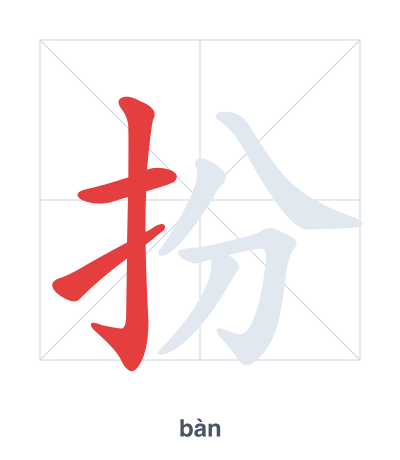
Open Hanzi Writer to see the animated stroke order and practice writing 扮 with real-time feedback.
The character 扮 (bàn) is written with 7 strokes. Follow the standard Chinese stroke order: top to bottom, left to right, outside before inside. The radical 扌 is one of its key components.
Practice the correct stroke order with the Hanzi Writer app to see animated stroke-by-stroke guidance with real-time feedback.
扮 means to dress up as; to play the part of.
As an HSK Level 5 character, 扮 is an intermediate-level character.
扮 combines the hand radical 扌 (action) with 分 (divide, separate). Originally meaning to mix or stir with hands, it later came to refer to dividing and arranging costumes and roles for a performance, hence 'to dress up as' or 'play the part of.'
💡 Memory Tip: Picture a hand (扌) dividing (分) different costumes to dress up for a role.
她打扮得很漂亮。
tā dǎ bàn dé hěn piào liàng
She is dressed up beautifully.
他扮演一个医生。
tā bàn yǎn yí gè yī shēng
He plays the role of a doctor.
他扮作小丑。
tā bàn zuò xiǎo chǒu
He dressed up as a clown.
Open Hanzi Writer to see the animated stroke order and practice writing 扮 with real-time feedback.
✨ Animated stroke order · Handwriting recognition · HSK-graded practice · Free to use
The left side is the radical 扌 (hand), indicating an action performed with the hands. The right side is 分 (fēn, to divide), hinting at the idea of changing one's appearance by dividing or transforming into another role.