痞 (pǐ) means "ruffian; abdominal lump" in Chinese. It has 12 strokes with the radical 疒.
Rated 4.2/5 in difficulty (advanced).
Appears in 3+ common words including 痞子 (pǐ zi), 地痞 (dì pǐ), 痞气 (pǐ qì).
Due to its 12 strokes, Hanzi Writer's error detection shows 痞 requires focused practice — most learners need 10+ attempts for consistent accuracy.
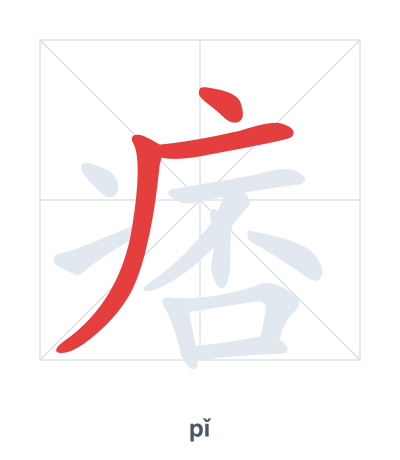
Open Hanzi Writer to see the animated stroke order and practice writing 痞 with real-time feedback.
The character 痞 (pǐ) is written with 12 strokes. Follow the standard Chinese stroke order: top to bottom, left to right, outside before inside. The radical 疒 is one of its key components.
Practice the correct stroke order with the Hanzi Writer app to see animated stroke-by-stroke guidance with real-time feedback.
痞 means ruffian; abdominal lump.
Combines the sickness radical 疒 (disease) with 否 (fǒu, meaning 'no' or 'to block'), together indicating a pathological blockage—an abdominal lump or a person who obstructs order (a ruffian).
💡 Memory Tip: Picture a sick person (疒) with a big lump on their belly, angrily shouting 'No!' (否) when anyone tries to poke it.
他看起来像个痞子。
tā kàn qǐ lái xiàng gè pǐ zi
He looks like a ruffian.
这里的地痞经常闹事。
zhè lǐ de dì pǐ jīng cháng nào shì
The local thugs here often cause trouble.
这个人身上有股痞气。
zhè ge rén shēn shàng yǒu gǔ pǐ qì
This person has a bit of a ruffian air about them.
Open Hanzi Writer to see the animated stroke order and practice writing 痞 with real-time feedback.
✨ Animated stroke order · Handwriting recognition · HSK-graded practice · Free to use
痞 is built with the radical 疒 (sickness) on the outside and 否 (pǐ, to negate or block) inside. The sickness radical indicates it relates to illness or disease, while 否 suggests a blockage or negativity, giving the original meaning of an abdominal lump or intestinal block. This structure combines the idea of a physical sickness with the sense of something being obstructed.