玻 (bō) means "glass" in Chinese. It has 9 strokes with the radical 王, and is HSK Level 5.
Rated 4/5 in difficulty (challenging).
Harder than 54% of HSK Level 5 characters.
Appears in 3+ common words including 玻璃 (bō lí), 玻璃杯 (bō lí bēi), 玻璃窗 (bō lí chuāng).
Due to its 9 strokes, Hanzi Writer's error detection shows 玻 requires focused practice — most learners need 10+ attempts for consistent accuracy.
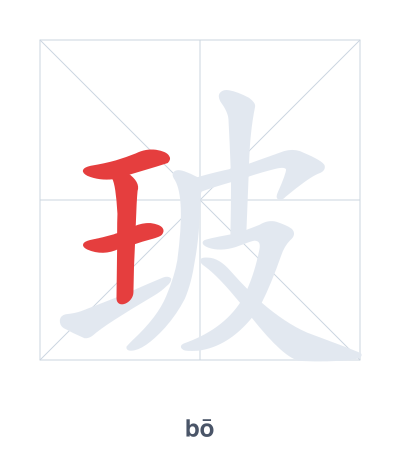
Open Hanzi Writer to see the animated stroke order and practice writing 玻 with real-time feedback.
The character 玻 (bō) is written with 9 strokes. Follow the standard Chinese stroke order: top to bottom, left to right, outside before inside. The radical 王 is one of its key components.
Practice the correct stroke order with the Hanzi Writer app to see animated stroke-by-stroke guidance with real-time feedback.
玻 means glass.
As an HSK Level 5 character, 玻 is an intermediate-level character.
玻 is a phono-semantic compound where 王 (jade radical) hints at the precious, translucent quality of glass, and 皮 (pí, meaning 'skin') provides the pronunciation. Glass was historically valued like jade for its beauty and transparency.
💡 Memory Tip: Picture a king (王) wearing a transparent skin (皮) made of glass, so everyone can see his royal jewels inside.
窗户上有玻璃。
chuāng hù shàng yǒu bō lí
There is glass on the window.
这是一个玻璃杯。
zhè shì yí gè bō lí bēi
This is a glass cup.
玻璃窗很干净。
bō lí chuāng hěn gān jìng
The glass window is very clean.
Open Hanzi Writer to see the animated stroke order and practice writing 玻 with real-time feedback.
✨ Animated stroke order · Handwriting recognition · HSK-graded practice · Free to use
玻 is made of two parts: the left radical 王 (which is actually the jade radical 玉) and the right side 皮 (skin). The jade radical suggests something shiny and valuable like jade, which helps you remember that glass is a smooth, transparent material. The right side 皮 gives a hint to the pronunciation, even though the tones differ.