㕡 (hé) means "A valley or a deep ravine." in Chinese. It has 14 strokes with the radical 口.
Rated 4.2/5 in difficulty (advanced).
Appears in 3+ common words including 山㕡 (shān hé), 水㕡 (shuǐ hé), 大㕡 (dà hé).
Due to its 14 strokes, Hanzi Writer's error detection shows 㕡 requires focused practice — most learners need 10+ attempts for consistent accuracy.
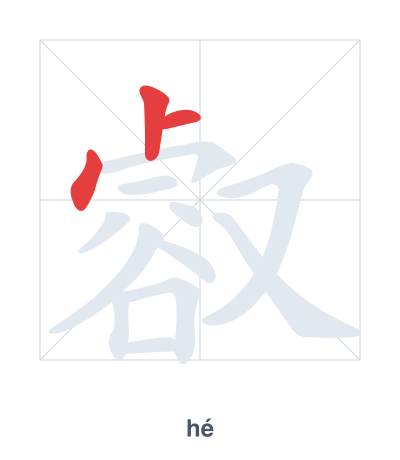
Open Hanzi Writer to see the animated stroke order and practice writing 㕡 with real-time feedback.
The character 㕡 (hé) is written with 14 strokes. Follow the standard Chinese stroke order: top to bottom, left to right, outside before inside. The radical 口 is one of its key components.
Practice the correct stroke order with the Hanzi Writer app to see animated stroke-by-stroke guidance with real-time feedback.
㕡 means A valley or a deep ravine..
The character 㕡 is a compound of 口 (a mouth or opening) placed above 谷 (a valley). Together, they depict the mouth or entrance of a deep valley, representing a ravine. This structure directly visualizes the meaning: an opening that leads into a steep, narrow valley.
💡 Memory Tip: Picture a giant mouth (口) gaping open at the top of a valley (谷) that plunges into a dark, deep ravine.
山㕡里有小水。
shān hé lǐ yǒu xiǎo shuǐ 。
There is a small stream in the mountain valley.
水流进了水㕡。
shuǐ liú jìn le shuǐ hé 。
Water flowed into the gully.
前面是一个大㕡。
qián miàn shì yí gè dà hé 。
There is a large ravine ahead.
Open Hanzi Writer to see the animated stroke order and practice writing 㕡 with real-time feedback.
✨ Animated stroke order · Handwriting recognition · HSK-graded practice · Free to use
The character 㕡 combines the radical 口 (mouth) on top and a lower part that resembles a deep valley shape. The 口 suggests an opening or entrance, while the bottom represents the ravine itself, so together they depict a valley with a mouth-like opening.