拔 (bá) means "To pull out / to pull up" in Chinese. It has 8 strokes with the radical 扌, and is HSK Level 5.
Rated 3.7/5 in difficulty (challenging).
Harder than 35% of HSK Level 5 characters.
Appears in 3+ common words including 拔牙 (bá yá), 拔草 (bá cǎo), 选拔 (xuǎn bá).
Due to its 8 strokes, Hanzi Writer's error detection shows 拔 requires focused practice — most learners need 10+ attempts for consistent accuracy.
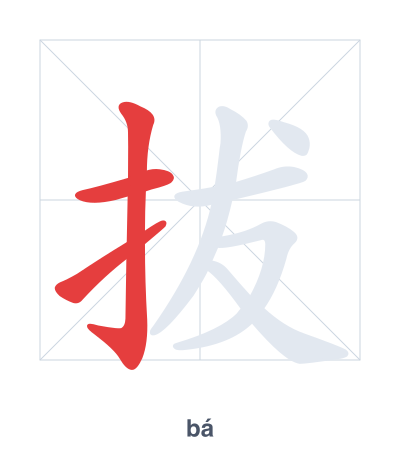
Open Hanzi Writer to see the animated stroke order and practice writing 拔 with real-time feedback.
The character 拔 (bá) is written with 8 strokes. Follow the standard Chinese stroke order: top to bottom, left to right, outside before inside. The radical 扌 is one of its key components.
Practice the correct stroke order with the Hanzi Writer app to see animated stroke-by-stroke guidance with real-time feedback.
拔 means To pull out / to pull up.
As an HSK Level 5 character, 拔 is an intermediate-level character.
拔 combines the hand radical 扌 with the phonetic component 犮, which originally depicted a dog straining against a leash. The hand indicates the action of pulling, so the character visually represents using your hand to pull something out or up.
💡 Memory Tip: Imagine a hand (扌) yanking a stubborn dog (犮) out of a hole by its tail.
我明天要去拔牙。
wǒ míng tiān yào qù bá yá
I'm going to get a tooth pulled tomorrow.
我们在花园里拔草。
wǒ men zài huā yuán lǐ bá cǎo
We are weeding in the garden.
选拔赛今天开始。
xuǎn bá sài jīn tiān kāi shǐ
The selection trials begin today.
Open Hanzi Writer to see the animated stroke order and practice writing 拔 with real-time feedback.
✨ Animated stroke order · Handwriting recognition · HSK-graded practice · Free to use
拔 consists of the radical 扌 (hand) on the left, and the phonetic component 犮 on the right. The hand radical suggests an action performed with the hand, and the overall character means using your hand to pull something out, like a tooth or a weed.