疡 (yáng) means "ulcer" in Chinese. It has 8 strokes with the radical 疒.
Rated 3.7/5 in difficulty (challenging).
Appears in 3+ common words including 溃疡 (kuì yáng), 口腔溃疡 (kǒu qiāng kuì yáng), 脓疡 (nóng yáng).
Due to its 8 strokes, Hanzi Writer's error detection shows 疡 requires focused practice — most learners need 10+ attempts for consistent accuracy.
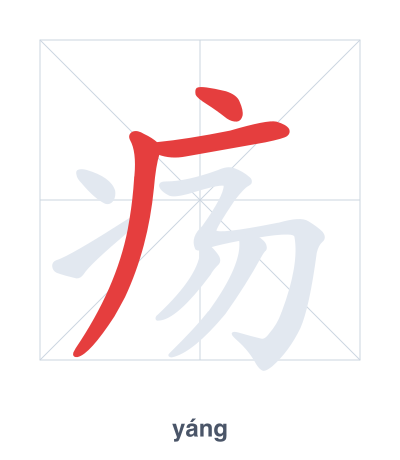
Open Hanzi Writer to see the animated stroke order and practice writing 疡 with real-time feedback.
The character 疡 (yáng) is written with 8 strokes. Follow the standard Chinese stroke order: top to bottom, left to right, outside before inside. The radical 疒 is one of its key components.
Practice the correct stroke order with the Hanzi Writer app to see animated stroke-by-stroke guidance with real-time feedback.
疡 means ulcer.
疡 (yáng) is a phono-semantic compound. The radical 疒 (illness) indicates it's a disease, while the component 昜 (yáng, meaning 'sun' or 'bright') gives the pronunciation and also suggests the hot, inflamed nature of an ulcer.
💡 Memory Tip: A sick person (疒) lying under the blazing sun (昜) develops a painful ulcer.
他患有胃溃疡。
tā huàn yǒu wèi kuì yáng
He suffers from a gastric ulcer.
我长了口腔溃疡。
wǒ zhǎng le kǒu qiāng kuì yáng
I have a mouth ulcer.
伤口形成了脓疡。
shāng kǒu xíng chéng le nóng yáng
The wound has formed an abscess.
Open Hanzi Writer to see the animated stroke order and practice writing 疡 with real-time feedback.
✨ Animated stroke order · Handwriting recognition · HSK-graded practice · Free to use
疡 has the radical 疒 (sickness) on the outside, showing it relates to illness. Inside is 昜 (yáng), which gives the sound and hints at a wound that spreads or festers. Together, they mean a skin ulcer or sore.