毒 (dú) means "Poison / Toxic" in Chinese. It has 9 strokes with the radical 母, and is HSK Level 5.
Rated 4/5 in difficulty (challenging).
Harder than 52% of HSK Level 5 characters.
Appears in 3+ common words including 病毒 (bìng dú), 中毒 (zhòng dú), 毒品 (dú pǐn).
Due to its 9 strokes, Hanzi Writer's error detection shows 毒 requires focused practice — most learners need 10+ attempts for consistent accuracy.
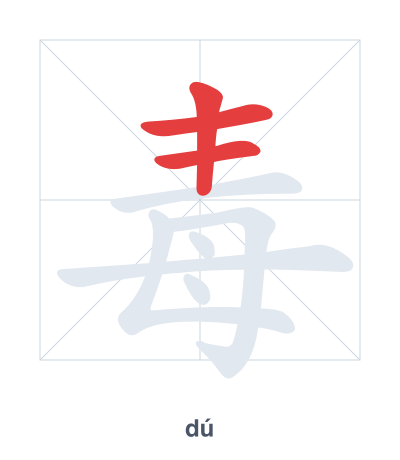
Open Hanzi Writer to see the animated stroke order and practice writing 毒 with real-time feedback.
The character 毒 (dú) is written with 9 strokes. Follow the standard Chinese stroke order: top to bottom, left to right, outside before inside. The radical 母 is one of its key components.
Practice the correct stroke order with the Hanzi Writer app to see animated stroke-by-stroke guidance with real-time feedback.
毒 means Poison / Toxic.
As an HSK Level 5 character, 毒 is an intermediate-level character.
毒 combines 艹 (grass) and 毋 (forbidden), originally depicting a poisonous plant that should be avoided. The component 毋 later merged with 母 in form, reinforcing the idea of something harmful associated with a mother's warning.
💡 Memory Tip: Picture a mother (母) nibbling on a grass (艹) and instantly realizing it's poison, spitting it out in disgust.
这种病毒传染很快。
zhè zhǒng bìng dú chuán rǎn hěn kuài
This virus spreads very quickly.
他食物中毒了。
tā shí wù zhòng dú le
He got food poisoning.
我们要远离毒品。
wǒ men yào yuǎn lí dú pǐn
We must stay away from drugs.
Open Hanzi Writer to see the animated stroke order and practice writing 毒 with real-time feedback.
✨ Animated stroke order · Handwriting recognition · HSK-graded practice · Free to use
The character 毒 is made of a top part that looks like 生 (life) but missing one stroke, and the bottom part 母 (mother). Together, they suggest something that harms or ends life, which relates to the meaning of poison or toxicity.