痛 (tòng) means "pain; ache" in Chinese. It has 12 strokes with the radical 疒, and is HSK Level 3.
Rated 4.2/5 in difficulty (advanced).
Harder than 86% of HSK Level 3 characters.
Appears in 3+ common words including 头痛 (tóu tòng), 肚子痛 (dù zi tòng), 牙痛 (yá tòng).
Due to its 12 strokes, Hanzi Writer's error detection shows 痛 requires focused practice — most learners need 10+ attempts for consistent accuracy.
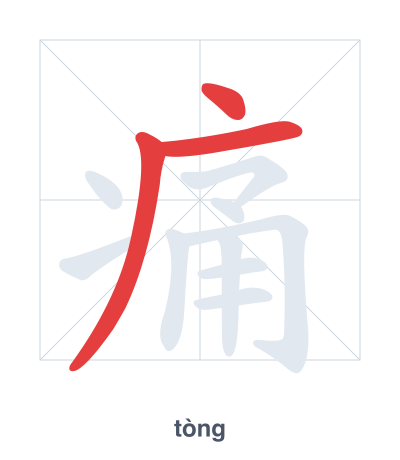
Open Hanzi Writer to see the animated stroke order and practice writing 痛 with real-time feedback.
The character 痛 (tòng) is written with 12 strokes. Follow the standard Chinese stroke order: top to bottom, left to right, outside before inside. The radical 疒 is one of its key components.
Practice the correct stroke order with the Hanzi Writer app to see animated stroke-by-stroke guidance with real-time feedback.
痛 means pain; ache.
As an HSK Level 3 character, 痛 is an intermediate-level character.
The character 痛 combines the radical 疒 (illness, depicting a sickbed) with the phonetic component 甬 (yǒng, 'tunnel' or 'path'). Together, the image suggests a blockage or obstruction in the body's pathways, causing pain.
💡 Memory Tip: Imagine a person lying on a sickbed (疒) with a heavy stone blocking a tunnel (甬) inside their body, causing sharp pain.
我今天有点儿头痛。
wǒ jīn tiān yǒu diǎn ér tóu tòng
I have a bit of a headache today.
他吃坏东西肚子痛。
tā chī huài dōng xi dù zi tòng
He has a stomachache from eating something bad.
牙痛要去看医生。
yá tòng yào qù kàn yī shēng
You should see a doctor if you have a toothache.
Open Hanzi Writer to see the animated stroke order and practice writing 痛 with real-time feedback.
✨ Animated stroke order · Handwriting recognition · HSK-graded practice · Free to use
痛 is made of the radical 疒 (illness) on the left and the phonetic component 甬 (yǒng) on the right. The radical 疒 shows that the character relates to sickness or discomfort. The right part gives a clue to pronunciation but does not directly contribute to the meaning.