僭 (jiàn) means "to overstep / to usurp" in Chinese. It has 14 strokes with the radical 亻.
Rated 3.9/5 in difficulty (challenging).
Appears in 3+ common words including 僭越 (jiàn yuè), 僭称 (jiàn chēng), 僭位 (jiàn wèi).
Due to its 14 strokes, Hanzi Writer's error detection shows 僭 requires focused practice — most learners need 10+ attempts for consistent accuracy.
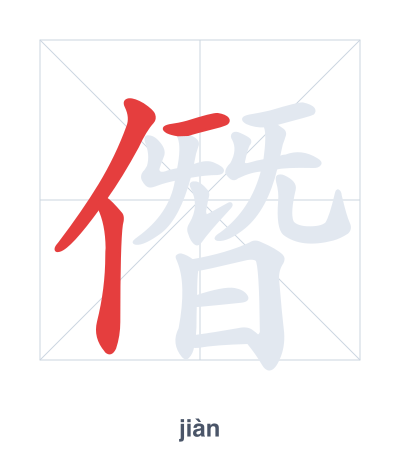
Open Hanzi Writer to see the animated stroke order and practice writing 僭 with real-time feedback.
The character 僭 (jiàn) is written with 14 strokes. Follow the standard Chinese stroke order: top to bottom, left to right, outside before inside. The radical 亻 is one of its key components.
Practice the correct stroke order with the Hanzi Writer app to see animated stroke-by-stroke guidance with real-time feedback.
僭 means to overstep / to usurp.
僭 is a compound character combining the person radical 亻 with 朁 (cǎn), which originally depicted a person advancing or exceeding limits. Together, they convey the idea of a person overstepping proper bounds, such as a subordinate usurping authority.
💡 Memory Tip: Imagine a person (亻) climbing over two stacked suns (兟) to steal the throne — an obvious overstep of rank.
这种行为属于僭越。
zhè zhǒng xíng wéi shǔ yú jiàn yuè
This behavior constitutes an overstepping of bounds.
他僭称自己是王。
tā jiàn chēng zì jǐ shì wáng
He claimed the title of king without right.
他想通过手段僭位。
tā xiǎng tōng guò shǒu duàn jiàn wèi
He wants to usurp the position through some means.
Open Hanzi Writer to see the animated stroke order and practice writing 僭 with real-time feedback.
✨ Animated stroke order · Handwriting recognition · HSK-graded practice · Free to use
僭 is made of the radical 亻 (person) on the left and 朁 on the right. The person radical hints that this word involves human action, while 朁 (which originally meant "to go beyond" or "to overstep") gives the core meaning of exceeding proper limits. Together they form the idea of a person overstepping their authority or rights.