悲 (bēi) means "sad; sorrowful" in Chinese. It has 12 strokes with the radical 心, and is HSK Level 5.
Rated 4.2/5 in difficulty (advanced).
Harder than 67% of HSK Level 5 characters.
Appears in 3+ common words including 悲伤 (bēi shāng), 悲剧 (bēi jù), 悲观 (bēi guān).
Due to its 12 strokes, Hanzi Writer's error detection shows 悲 requires focused practice — most learners need 10+ attempts for consistent accuracy.
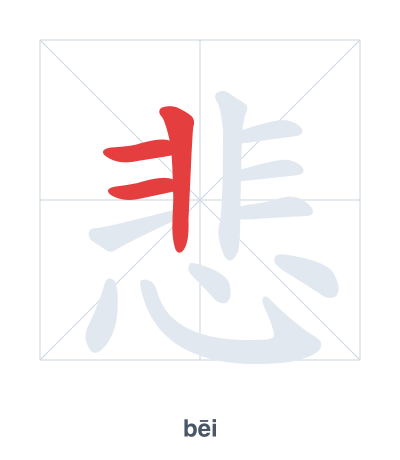
Open Hanzi Writer to see the animated stroke order and practice writing 悲 with real-time feedback.
The character 悲 (bēi) is written with 12 strokes. Follow the standard Chinese stroke order: top to bottom, left to right, outside before inside. The radical 心 is one of its key components.
Practice the correct stroke order with the Hanzi Writer app to see animated stroke-by-stroke guidance with real-time feedback.
悲 means sad; sorrowful.
As an HSK Level 5 character, 悲 is an intermediate-level character.
悲 is a compound character with 非 (wrong/negative) over 心 (heart). The idea is a heart that feels wrong or broken, leading to sadness.
💡 Memory Tip: Picture a heart (心) cracked in two by a pair of slashes (非), making it sad.
别为这件事悲伤。
bié wèi zhè jiàn shì bēi shāng
Don't be sad about this.
这是一部感人的悲剧。
zhè shì yī bù gǎn rén de bēi jù
This is a touching tragedy.
我们不要太悲观。
wǒ men bú yào tài bēi guān
We shouldn't be too pessimistic.
Open Hanzi Writer to see the animated stroke order and practice writing 悲 with real-time feedback.
✨ Animated stroke order · Handwriting recognition · HSK-graded practice · Free to use
悲 combines the top part 非 (meaning wrong or not) with the bottom radical 心 (heart). This suggests a "wrong-hearted" or broken heart feeling, which leads to sadness or sorrow. The structure visually shows emotion (heart) and something negative (非).