慰 (wèi) means "to comfort; to console" in Chinese. It has 15 strokes with the radical 心, and is HSK Level 5.
Rated 4.2/5 in difficulty (advanced).
Harder than 68% of HSK Level 5 characters.
Appears in 3+ common words including 安慰 (ān wèi), 欣慰 (xīn wèi), 慰问 (wèi wèn).
Due to its 15 strokes, Hanzi Writer's error detection shows 慰 requires focused practice — most learners need 10+ attempts for consistent accuracy.
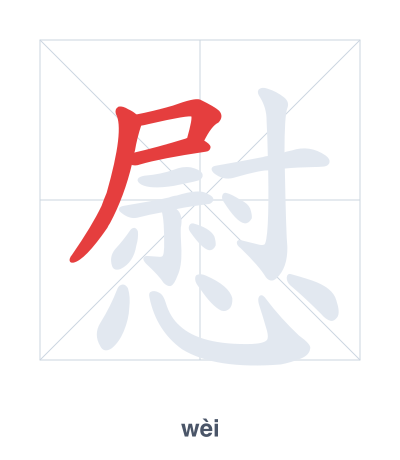
Open Hanzi Writer to see the animated stroke order and practice writing 慰 with real-time feedback.
The character 慰 (wèi) is written with 15 strokes. Follow the standard Chinese stroke order: top to bottom, left to right, outside before inside. The radical 心 is one of its key components.
Practice the correct stroke order with the Hanzi Writer app to see animated stroke-by-stroke guidance with real-time feedback.
慰 means to comfort; to console.
As an HSK Level 5 character, 慰 is an intermediate-level character.
慰 combines 尉 (to pacify, originally depicting a hand pressing down on a person) with the heart radical 心, together meaning to calm someone's heart by offering comfort.
💡 Memory Tip: Picture a person (尸) using a hand (寸) to gently pat a heart (心) to soothe it.
别哭,我安慰你。
bié kū wǒ ān wèi nǐ
Don't cry, I'll comfort you.
妈妈感到很欣慰。
mā mā gǎn dào hěn xīn wèi
Mom feels very gratified.
我们去慰问老人。
wǒ men qù wèi wèn lǎo rén
Let's go visit the elderly.
Open Hanzi Writer to see the animated stroke order and practice writing 慰 with real-time feedback.
✨ Animated stroke order · Handwriting recognition · HSK-graded practice · Free to use
慰 is composed of 尉 on top and 心 (heart) at the bottom. The 心 radical indicates that the meaning involves emotions or feelings, while 尉 provides the pronunciation. Together, they create the idea of using one's heart to comfort someone.