Frequently Asked Questions
Everything you need to know about learning Chinese handwriting with Hanzi Writer.
Is handwriting necessary for learning Chinese?
Yes. Research in cognitive psychology shows that the motor act of writing strengthens character recognition and recall far more than visual study alone. Handwriting engages spatial memory, making it easier to distinguish similar-looking characters like 己/已/巳.
How many Chinese characters should beginners know?
HSK 1 covers about 300 characters, enough for basic greetings and survival phrases. HSK 1–3 (about 1,000 characters) lets you read simple texts. For daily life in China, 2,500–3,000 characters cover 99% of common usage.
What is the best review interval for Chinese characters?
Spaced repetition works best: review after 1 day, then 3 days, 7 days, 14 days, and 30 days. Hanzi Writer's built-in SRS automatically schedules each character based on your performance, so you review right before you'd forget.
Should I learn Simplified or Traditional Chinese first?
If your goal is mainland China, Singapore, or HSK exams, start with Simplified. If you plan to study in Taiwan or read classical texts, Traditional may be better. Hanzi Writer focuses on Simplified characters aligned with HSK standards.
Can children use Hanzi Writer?
Yes. The stroke-by-stroke guided practice is ideal for children aged 5+. The visual feedback and gamified progress tracking keep young learners engaged. Many parents use it alongside YCT (Youth Chinese Test) preparation.
How do radicals help memorize characters?
Radicals are semantic components that hint at meaning. For example, 氵(water) appears in 河 (river), 海 (sea), 洗 (wash). Learning the 214 radicals gives you a systematic framework to decode and remember thousands of characters instead of memorizing each one independently.
Is Hanzi Writer free?
Yes, the core features — stroke practice, HSK courses, and SRS review — are completely free. A Pro subscription unlocks cloud sync, AI-generated topics, unlimited character lists, and an ad-free experience.
Does Hanzi Writer work offline?
Yes. All stroke data, character information, and practice content are stored on-device. You can practice anywhere — on a plane, subway, or in areas with no signal — without any internet connection.
What platforms does Hanzi Writer support?
Hanzi Writer is available on iOS (iPhone and iPad) and Android. Your progress syncs across devices with a Pro subscription.
How is Hanzi Writer different from a dictionary app?
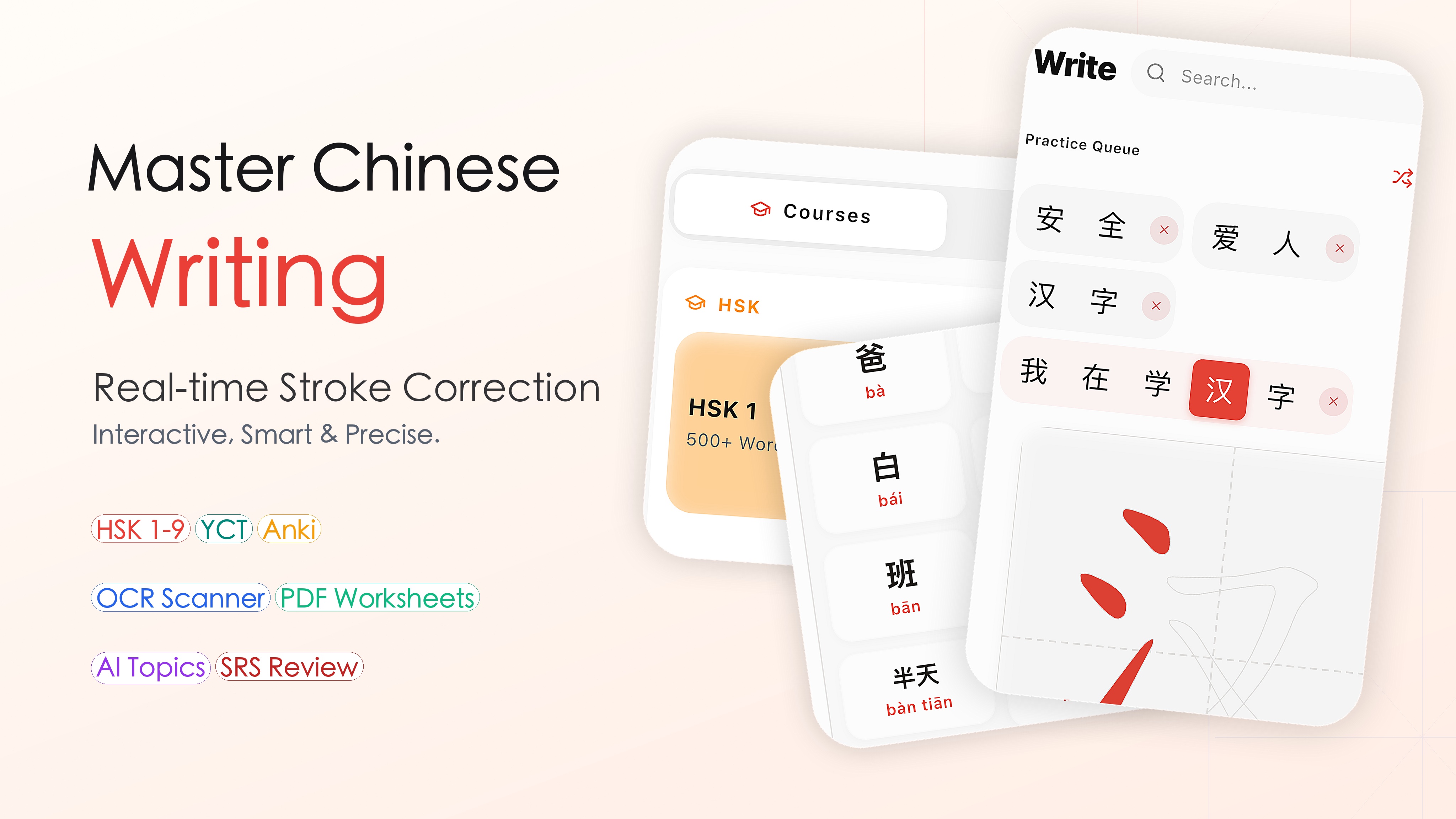
Dictionary apps show you what a character looks like; Hanzi Writer teaches you how to write it. Real-time stroke correction, guided animations, OCR scoring, and spaced repetition are designed specifically for building handwriting muscle memory.
What is stroke order and why does it matter?
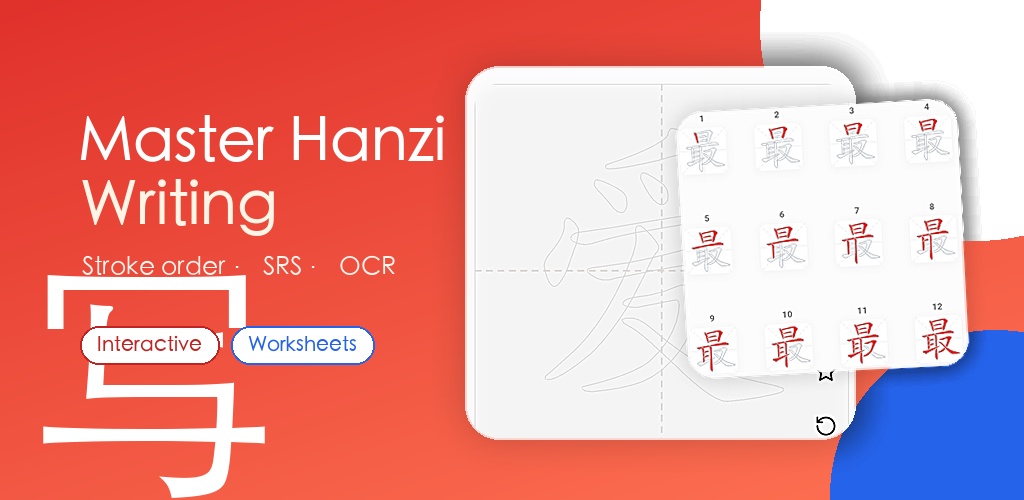
Stroke order is the prescribed sequence for writing each stroke of a character. Correct order produces balanced proportions, faster writing speed, and is essential for dictionary lookup by stroke count. There are 7 basic rules: top to bottom, left to right, horizontal before vertical, outside before inside, and more.
How many strokes does a Chinese character have?
Characters range from 1 stroke (一) to over 30 strokes (like 齉, 36 strokes). Most common characters have 5–15 strokes. Hanzi Writer includes stroke count data for all 7,450+ characters, and you can browse characters grouped by stroke count.
What is the HSK exam?
HSK (Hanyu Shuiping Kaoshi) is the standardized Chinese proficiency test administered by Hanban/CTI. It has 9 levels (new standard): HSK 1–3 for beginners, 4–6 for intermediate, and 7–9 for advanced. Hanzi Writer's character courses are organized by HSK level so you study exactly what the exam requires.
Can I practice on paper instead of screen?
Yes. Hanzi Writer generates printable PDF worksheets with tian zi ge (田字格) grid paper for any character or character list. Many learners alternate between digital practice for feedback and paper practice for natural pen feel.
How does the OCR scoring work?
After you write a character freehand (on screen or photograph paper writing), the on-device OCR engine compares your output against the standard form. It scores proportion, stroke placement, and overall accuracy — all processed locally without sending data to any server.
How long does it take to learn 1,000 Chinese characters?
With 20–30 minutes of daily practice using spaced repetition, most learners can comfortably write 1,000 characters in 3–4 months. Consistency matters more than session length — short daily practice beats weekend cramming.
What are the 7 basic strokes in Chinese?
The fundamental strokes are: héng (横, horizontal), shù (竖, vertical), piě (撇, left-falling), nà (捺, right-falling), diǎn (点, dot), tí (提, rising), and gōu (钩, hook). All complex strokes are combinations of these seven.
Does Hanzi Writer teach pronunciation or tones?
Hanzi Writer focuses on handwriting. Each character page shows pinyin with tone marks for reference, but the app's core strength is stroke order, writing practice, and character memorization. For pronunciation, pair it with a dedicated speaking app.
Can I create custom character lists?
Yes. Beyond the built-in HSK and YCT courses, you can create custom topics with any combination of characters — for a specific textbook, exam, or personal goal. Pro users can also generate AI-powered topic suggestions.
Is my data private?
Yes. All writing recognition and OCR processing happens on your device. Your practice data never leaves your phone unless you explicitly enable cloud sync (Pro feature). We do not sell or share personal data with third parties.
What is a tian zi ge (田字格)?
A tian zi ge is a square grid divided into four quadrants by dashed lines, used for practicing Chinese character proportions. The grid helps learners position each stroke correctly relative to the center. Hanzi Writer uses this grid in both digital practice and printable worksheets.
How does Hanzi Writer compare to Anki for characters?
Anki is a general-purpose flashcard tool — great for recognition but cannot teach handwriting. Hanzi Writer combines SRS with active writing practice, stroke correction, and structured HSK curriculum. It's specifically designed for the motor skill of writing, not just passive recall.
Can I use Hanzi Writer for the AP Chinese exam?
Yes. AP Chinese requires handwriting ability, and Hanzi Writer's character practice covers the vocabulary needed. Focus on HSK 3–5 characters for AP-level writing proficiency, and use the printable worksheets for timed practice.
What makes Chinese characters hard to learn?
Unlike alphabetic scripts, Chinese characters are logographic — each has a unique shape with multiple strokes in specific positions. The challenge is threefold: remembering the visual form, reproducing it accurately by hand, and retaining it long-term. Hanzi Writer addresses all three with guided writing, correction, and SRS.
How often is the character data updated?
Stroke order data follows the official standard (GB13000.1) and is verified once published. Vocabulary lists and HSK alignments are reviewed monthly against the latest Hanban publications. Etymology and mnemonic content is continuously improved.
Do I need a stylus to practice?
No. Hanzi Writer works perfectly with your finger on any touchscreen. A stylus can provide a more natural pen feel on tablets, but it's completely optional. The stroke correction algorithm works equally well with finger input.
What is the difference between 笔画 (strokes) and 部首 (radicals)?
Strokes (笔画) are the individual pen movements that compose a character (horizontal, vertical, dot, etc.). Radicals (部首) are meaningful components used to categorize characters in dictionaries — like 木 (tree) in 林 (forest). Strokes are about how to write; radicals are about what characters mean.
Can teachers use Hanzi Writer in classrooms?
Absolutely. Teachers use the printable worksheets for homework, assign specific HSK levels as weekly goals, and track student progress. The structured curriculum from HSK 1 to 9 maps naturally to semester-based teaching plans.
How does spaced repetition (SRS) work in Hanzi Writer?
Each character you practice gets a memory strength score. When the algorithm predicts you're about to forget (based on the forgetting curve), it schedules a review. Correct answers increase the interval; mistakes shorten it. This ensures you spend time only on characters that need reinforcement.
What is the fastest way to memorize Chinese characters?
Combine three techniques: (1) decompose characters into radicals to understand their logic, (2) write each character repeatedly with correct stroke order to build motor memory, and (3) use spaced repetition to move characters from short-term to long-term memory. Hanzi Writer integrates all three in one workflow.