僳 (sù) means "Lisu (ethnic group)" in Chinese. It has 14 strokes with the radical 亻.
Rated 3.9/5 in difficulty (challenging).
Appears in 3+ common words including 傈僳族 (lì sù zú), 傈僳语 (lì sù yǔ), 傈僳家 (lì sù jiā).
Due to its 14 strokes, Hanzi Writer's error detection shows 僳 requires focused practice — most learners need 10+ attempts for consistent accuracy.
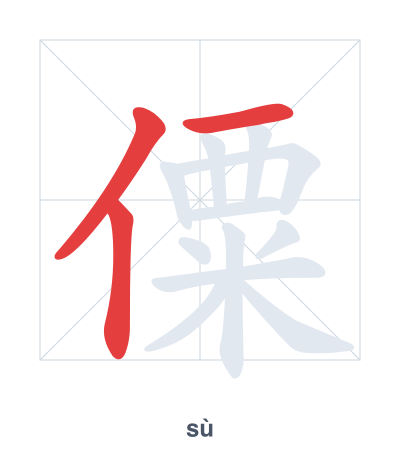
Open Hanzi Writer to see the animated stroke order and practice writing 僳 with real-time feedback.
The character 僳 (sù) is written with 14 strokes. Follow the standard Chinese stroke order: top to bottom, left to right, outside before inside. The radical 亻 is one of its key components.
Practice the correct stroke order with the Hanzi Writer app to see animated stroke-by-stroke guidance with real-time feedback.
僳 means Lisu (ethnic group).
The character 僳 combines the radical 亻 (person) with 粟 (millet, sù), which also provides the pronunciation. This suggests the Lisu people's historical association with millet farming, though the character was likely created as a phonetic loan to represent the ethnic group's name.
💡 Memory Tip: Picture a person (亻) carrying a sack of millet (粟) to represent the Lisu people's agricultural heritage.
他是傈僳族人。
tā shì lì sù zú rén
He is of the Lisu ethnic group.
我想学傈僳语。
wǒ xiǎng xué lì sù yǔ
I want to learn the Lisu language.
走进傈僳人家里。
zǒu jìn lì sù rén jiā lǐ
Walking into a Lisu person's home.
Open Hanzi Writer to see the animated stroke order and practice writing 僳 with real-time feedback.
✨ Animated stroke order · Handwriting recognition · HSK-graded practice · Free to use
The character 僳 consists of the radical 亻 (person) on the left and the phonetic component 㐭 (a rare character pronounced lǐn) on the right. The radical 亻 indicates that the meaning relates to people, and together with the phonetic part, it represents the Lisu ethnic group. This structure is similar to other ethnic group names like 傈 (Lì) in 傈僳族.