拜 (bài) means "To worship / to pay respect / to visit" in Chinese. It has 9 strokes with the radical 扌, and is HSK Level 5.
Rated 4/5 in difficulty (challenging).
Harder than 49% of HSK Level 5 characters.
Appears in 3+ common words including 拜访 (bài fǎng), 拜年 (bài nián), 礼拜 (lǐ bài).
Due to its 9 strokes, Hanzi Writer's error detection shows 拜 requires focused practice — most learners need 10+ attempts for consistent accuracy.
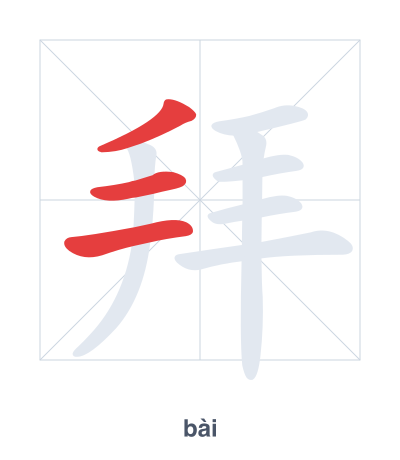
Open Hanzi Writer to see the animated stroke order and practice writing 拜 with real-time feedback.
The character 拜 (bài) is written with 9 strokes. Follow the standard Chinese stroke order: top to bottom, left to right, outside before inside. The radical 扌 is one of its key components.
Practice the correct stroke order with the Hanzi Writer app to see animated stroke-by-stroke guidance with real-time feedback.
拜 means To worship / to pay respect / to visit.
As an HSK Level 5 character, 拜 is an intermediate-level character.
The character 拜 originally depicted two hands clasped together in a respectful gesture, symbolizing worship or bowing. Its left radical 扌 represents a hand, while the right component 㐭 (a phonetic element) contributes to the pronunciation. Together, they convey the act of paying respect with folded hands.
💡 Memory Tip: Imagine a hand (扌) pressing down on a person kneeling and bowing low (the right side resembles a bent figure) to show deep respect.
我去拜访老师。
wǒ qù bài fǎng lǎo shī
I'm going to visit my teacher.
大家互相拜年。
dà jiā hù xiāng bài nián
Everyone exchanged New Year greetings.
今天礼拜天。
jīn tiān lǐ bài tiān
Today is Sunday.
Open Hanzi Writer to see the animated stroke order and practice writing 拜 with real-time feedback.
✨ Animated stroke order · Handwriting recognition · HSK-graded practice · Free to use
拜 is composed of the hand radical 扌 on the left and a right component that originally showed two hands clasped together. The hand radical indicates the action involves the hands, while the clasped hand shape represents a respectful greeting or worship. Together, they convey the meaning of paying respect, worshiping, or visiting.