疠 (lì) means "pestilence" in Chinese. It has 8 strokes with the radical 疒.
Rated 3.7/5 in difficulty (challenging).
Appears in 3+ common words including 疫疠 (yì lì), 疠气 (lì qì), 恶疠 (è lì).
Due to its 8 strokes, Hanzi Writer's error detection shows 疠 requires focused practice — most learners need 10+ attempts for consistent accuracy.
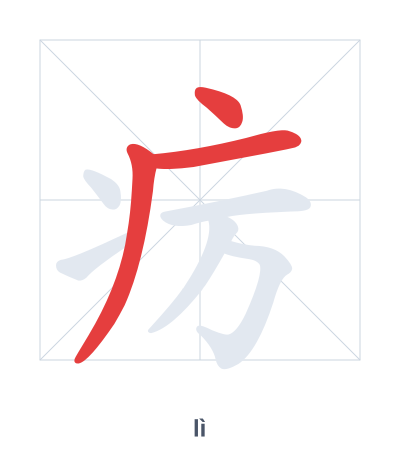
Open Hanzi Writer to see the animated stroke order and practice writing 疠 with real-time feedback.
The character 疠 (lì) is written with 8 strokes. Follow the standard Chinese stroke order: top to bottom, left to right, outside before inside. The radical 疒 is one of its key components.
Practice the correct stroke order with the Hanzi Writer app to see animated stroke-by-stroke guidance with real-time feedback.
疠 means pestilence.
This character combines the sickness radical 疒 with 历 (lì), meaning 'to pass through' or 'calendar,' suggesting a disease that spreads through a community. In its traditional form 癘, the phonetic 厲 (lì) means 'severe,' emphasizing the devastating nature of pestilence.
💡 Memory Tip: Picture a sick person in bed (疒) staring at a calendar (历) that counts down the days until a deadly pestilence arrives.
这种疫疠传播很快。
zhè zhǒng yì lì chuán bō hěn kuài
This pestilence spreads very quickly.
古人认为这是疠气。
gǔ rén rèn wéi zhè shì lì qì
Ancient people believed this was a pestilential miasma.
这种恶疠很难治愈。
zhè zhǒng è lì hěn nán zhì yù
This malignant disease is very difficult to cure.
Open Hanzi Writer to see the animated stroke order and practice writing 疠 with real-time feedback.
✨ Animated stroke order · Handwriting recognition · HSK-graded practice · Free to use
疠 combines the radical 疒, meaning illness or disease, with the component 万, which means 'ten thousand'. The radical shows the character is related to sickness, while 万 suggests a disease that spreads to many people, forming the idea of a widespread pestilence.