辈 (bèi) means "Generation; lifetime" in Chinese. It has 12 strokes with the radical 非, and is HSK Level 5.
Rated 3.8/5 in difficulty (challenging).
Harder than 41% of HSK Level 5 characters.
Appears in 3+ common words including 长辈 (zhǎng bèi), 一辈子 (yī bèi zi), 后辈 (hòu bèi).
Due to its 12 strokes, Hanzi Writer's error detection shows 辈 requires focused practice — most learners need 10+ attempts for consistent accuracy.
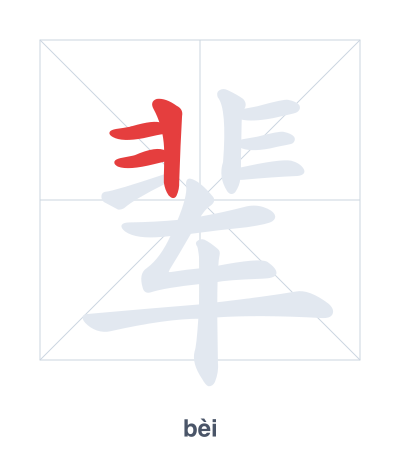
Open Hanzi Writer to see the animated stroke order and practice writing 辈 with real-time feedback.
The character 辈 (bèi) is written with 12 strokes. Follow the standard Chinese stroke order: top to bottom, left to right, outside before inside. The radical 非 is one of its key components.
Practice the correct stroke order with the Hanzi Writer app to see animated stroke-by-stroke guidance with real-time feedback.
辈 means Generation; lifetime.
As an HSK Level 5 character, 辈 is an intermediate-level character.
辈 is a phono-semantic compound where 车 (chariot) gives meaning and 非 (originally depicting wings as a phonetic clue) gives sound. It originally referred to a group of a hundred chariots, later extending to mean a group of people of the same generation or a lifetime.
💡 Memory Tip: Imagine a row of old-fashioned cars (车) lined up side by side, each representing one generation, with the two sides of 非 showing the divide between past and future.
我们要尊敬长辈。
wǒ men yào zūn jìng zhǎng bèi
We should respect our elders.
他一辈子都在这里。
tā yī bèi zi dōu zài zhè lǐ
He has been here his whole life.
他非常关心后辈。
tā fēi cháng guān xīn hòu bèi
He cares a lot about the younger generation.
Open Hanzi Writer to see the animated stroke order and practice writing 辈 with real-time feedback.
✨ Animated stroke order · Handwriting recognition · HSK-graded practice · Free to use
The character 辈 is composed of 非 (fēi, meaning 'wrong' or 'not') on top and 车 (chē, meaning 'vehicle') on the bottom. Historically, the combination suggested rows of chariots, which came to represent different groups or generations. This structure reflects the idea of successive lines, like generations following one another.