彼 (bǐ) means "that; those; the other" in Chinese. It has 8 strokes with the radical 彳, and is HSK Level 5.
Rated 3.7/5 in difficulty (challenging).
Harder than 33% of HSK Level 5 characters.
Appears in 3+ common words including 彼此 (bǐ cǐ), 彼岸 (bǐ àn), 知彼 (zhī bǐ).
Due to its 8 strokes, Hanzi Writer's error detection shows 彼 requires focused practice — most learners need 10+ attempts for consistent accuracy.
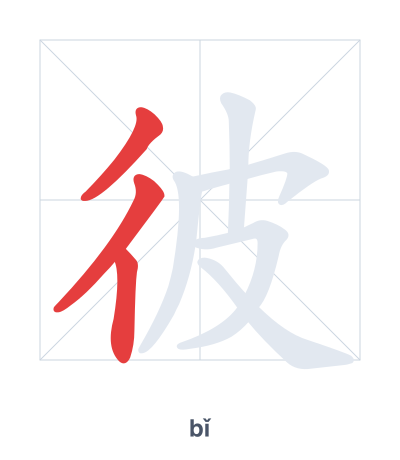
Open Hanzi Writer to see the animated stroke order and practice writing 彼 with real-time feedback.
The character 彼 (bǐ) is written with 8 strokes. Follow the standard Chinese stroke order: top to bottom, left to right, outside before inside. The radical 彳 is one of its key components.
Practice the correct stroke order with the Hanzi Writer app to see animated stroke-by-stroke guidance with real-time feedback.
彼 means that; those; the other.
As an HSK Level 5 character, 彼 is an intermediate-level character.
The character 彼 combines the radical 彳 (step, indicating movement) with 皮 (skin, hide) which provides the phonetic component and also suggests something outer or distant. Originally meaning 'to go toward' or 'the other side,' it evolved into a demonstrative pronoun for 'that' or 'those.'
💡 Memory Tip: Imagine stepping (彳) over a animal skin (皮) to reach 'that' other side.
我们彼此都很信任。
wǒ men bǐ cǐ dōu hěn xìn rèn
We trust each other very much.
小船划向了彼岸。
xiǎo chuán huà xiàng le bǐ àn
The small boat rowed toward the other shore.
知己知彼,百战百胜。
zhī jǐ zhī bǐ bǎi zhàn bǎi shèng
Know yourself and know your enemy, and you will never be defeated.
Open Hanzi Writer to see the animated stroke order and practice writing 彼 with real-time feedback.
✨ Animated stroke order · Handwriting recognition · HSK-graded practice · Free to use
The character 彼 consists of the radical 彳 (left step) on the left and the phonetic component 皮 (skin, leather) on the right. The radical 彳 suggests movement or a path, and 皮 provides the pronunciation bǐ. Together, they originally indicated 'that direction' or 'the other side,' which evolved into the meaning 'that; those; the other.'