疚 (jiù) means "Remorse; regret; chronic illness" in Chinese. It has 8 strokes with the radical 疒.
Rated 3.7/5 in difficulty (challenging).
Appears in 3+ common words including 愧疚 (kuì jiù), 内疚 (nèi jiù), 歉疚 (qiàn jiù).
Due to its 8 strokes, Hanzi Writer's error detection shows 疚 requires focused practice — most learners need 10+ attempts for consistent accuracy.
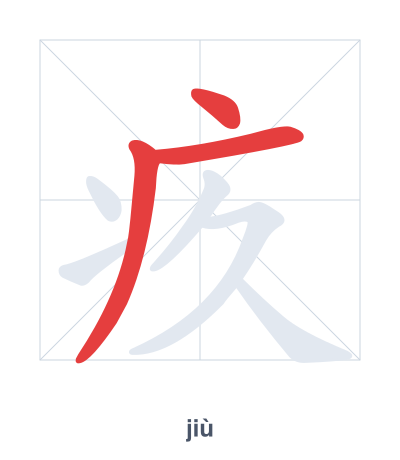
Open Hanzi Writer to see the animated stroke order and practice writing 疚 with real-time feedback.
The character 疚 (jiù) is written with 8 strokes. Follow the standard Chinese stroke order: top to bottom, left to right, outside before inside. The radical 疒 is one of its key components.
Practice the correct stroke order with the Hanzi Writer app to see animated stroke-by-stroke guidance with real-time feedback.
疚 means Remorse; regret; chronic illness.
疚 combines the radical 疒 (sickness) with 久 (long time), indicating a lingering illness or a long-lasting pain of remorse. The ancient form of 疒 depicts a bed with a person lying sick, reinforcing the idea of affliction. Together, 疚 visually suggests a chronic condition—whether physical or emotional—that persists over time.
💡 Memory Tip: Imagine a sick person (疒) trapped in a long, endless day (久), constantly replaying their mistake—a lasting guilt. 疚
我心里觉得很愧疚。
wǒ xīn lǐ jué de hěn kuì jiù
I feel very guilty.
他为此感到非常内疚。
tā wèi cǐ gǎn dào fēi cháng nèi jiù
He felt very guilty about this.
他的眼神里充满歉疚。
tā de yǎn shén lǐ chōng mǎn qiàn jiù
His eyes are full of guilt and apology.
Open Hanzi Writer to see the animated stroke order and practice writing 疚 with real-time feedback.
✨ Animated stroke order · Handwriting recognition · HSK-graded practice · Free to use
The character 疚 combines the radical 疒 (illness) with 久 (long duration). The radical sets the meaning of sickness or ailment, while 久 suggests something lasting over time. Together they convey the idea of a chronic illness or a lingering feeling of remorse.