疣 (yóu) means "wart" in Chinese. It has 9 strokes with the radical 疒.
Rated 4/5 in difficulty (challenging).
Appears in 3+ common words including 疣子 (yóu zi), 扁平疣 (biǎn píng yóu), 寻常疣 (xún cháng yóu).
Due to its 9 strokes, Hanzi Writer's error detection shows 疣 requires focused practice — most learners need 10+ attempts for consistent accuracy.
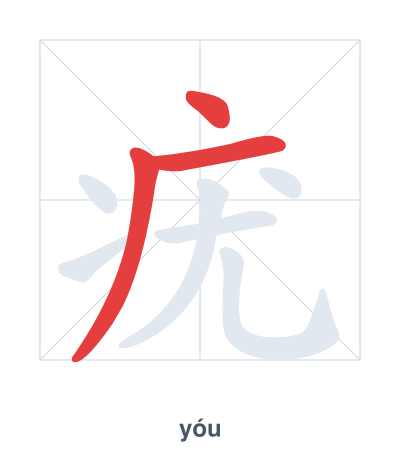
Open Hanzi Writer to see the animated stroke order and practice writing 疣 with real-time feedback.
The character 疣 (yóu) is written with 9 strokes. Follow the standard Chinese stroke order: top to bottom, left to right, outside before inside. The radical 疒 is one of its key components.
Practice the correct stroke order with the Hanzi Writer app to see animated stroke-by-stroke guidance with real-time feedback.
疣 means wart.
The character 疣 combines the illness radical 疒 (sickness) with 尤, which originally depicted a hand with an extra growth or blemish. Together, they signify a wart as a skin disease.
💡 Memory Tip: Imagine a sick person (疒) with a big ugly extra finger (like the curved shape of 尤) growing out of their hand—that's a wart.
他手上长了一个疣子。
tā shǒu shàng zhǎng le yí gè yóu zi
He has a wart on his hand.
这种药可以治扁平疣。
zhè zhǒng yào kě yǐ zhì biǎn píng yóu
This medicine can treat flat warts.
寻常疣很常见。
xún cháng yóu hěn cháng jiàn
Common warts are very common.
Open Hanzi Writer to see the animated stroke order and practice writing 疣 with real-time feedback.
✨ Animated stroke order · Handwriting recognition · HSK-graded practice · Free to use
疣 is composed of the radical 疒 (illness or sickness) on the left and the phonetic component 尤 (yóu) on the right. The radical 疒 indicates that the character relates to a disease or medical condition, while 尤 provides the pronunciation. Together, they form the meaning "wart," a type of skin growth that is often considered a minor illness.