吐 (tǔ/tù) means "to spit; to vomit" in Chinese. It has 6 strokes with the radical 口, and is HSK Level 5.
Rated 3.2/5 in difficulty (challenging).
Harder than 13% of HSK Level 5 characters.
Appears in 4+ common words including 吐露 (tǔ lù), 吐字 (tǔ zì), 呕吐 (ǒu tù).
Due to its 6 strokes, Hanzi Writer's error detection shows 吐 requires focused practice — most learners need 10+ attempts for consistent accuracy.
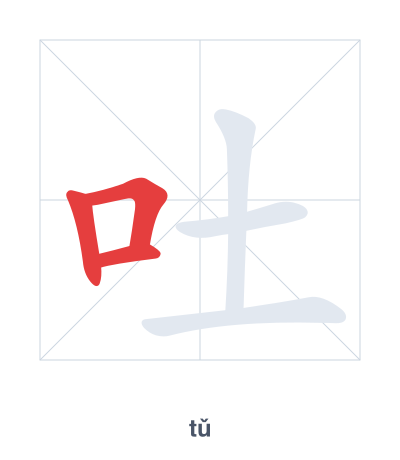
Open Hanzi Writer to see the animated stroke order and practice writing 吐 with real-time feedback.
The character 吐 (tǔ/tù) is written with 6 strokes. Follow the standard Chinese stroke order: top to bottom, left to right, outside before inside. The radical 口 is one of its key components.
Practice the correct stroke order with the Hanzi Writer app to see animated stroke-by-stroke guidance with real-time feedback.
吐 means to spit; to vomit.
This is a polyphonic character with readings: tǔ, tù.
As an HSK Level 5 character, 吐 is an intermediate-level character.
吐 is a phono-semantic compound: the mouth radical 口 indicates the action of expelling from the mouth, while 土 (tǔ, 'earth') provides the pronunciation. Together they evoke the image of spitting out dirt, directly linking to the meanings 'to spit' and 'to vomit.'
💡 Memory Tip: Imagine a mouth (口) spitting out a lump of dirt (土) in disgust.
他向最好的朋友吐露了自己的心声。
tā xiàng zuì hǎo de péng yǒu tǔ lù le zì jǐ de xīn shēng
He poured out his heart to his best friend.
播音员的吐字非常清晰圆润。
bō yīn yuán de tǔ zì fēi cháng qīng xī yuán rùn
The announcer's pronunciation is very clear and mellow.
他晕船得厉害,一直在不停地呕吐。
tā yùn chuán dé lì hài yì zhí zài bù tíng dì ǒu tù
He is very seasick and has been vomiting constantly.
这个感人的情节让他几乎要伤心吐血。
zhè ge gǎn rén de qíng jié ràng tā jī hū yào shāng xīn tù xiě
This touching plot almost made him spit blood from grief.
Open Hanzi Writer to see the animated stroke order and practice writing 吐 with real-time feedback.
✨ Animated stroke order · Handwriting recognition · HSK-graded practice · Free to use
吐 is made of the radical 口 (mouth) on the left and 土 (earth/dirt) on the right. The mouth radical suggests an action done with the mouth, while the dirt component hints at the idea of ejecting something unwanted, like spitting or vomiting.