买 (mǎi) means "to buy" in Chinese. It has 6 strokes with the radical 大, and is HSK Level 1.
Rated 2.4/5 in difficulty (moderate).
Harder than 27% of HSK Level 1 characters.
Appears in 3+ common words including 买东西 (mǎi dōng xī), 买菜 (mǎi cài), 买票 (mǎi piào).
Hanzi Writer's stroke validation shows learners typically need 5-8 attempts to write 买 with correct proportion and order.
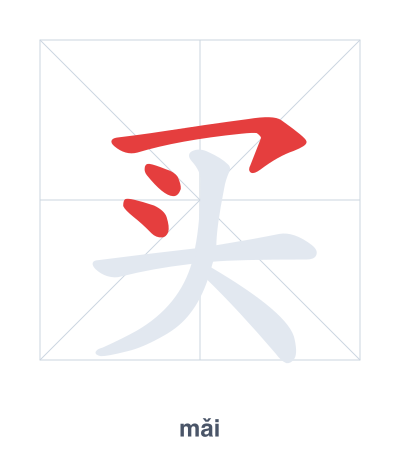
Open Hanzi Writer to see the animated stroke order and practice writing 买 with real-time feedback.
The character 买 (mǎi) is written with 6 strokes. Follow the standard Chinese stroke order: top to bottom, left to right, outside before inside. The radical 大 is one of its key components.
Practice the correct stroke order with the Hanzi Writer app to see animated stroke-by-stroke guidance with real-time feedback.
买 means to buy.
As an HSK Level 1 character, 买 is among the first characters beginners learn.
The original form 買 combines a net (网) over shells (貝), ancient currency. This depicts 'netting' or acquiring goods with money, hence 'to buy'. The simplified 买 replaces the shell radical with 大 (big) and a simplified net shape, retaining the idea of a transaction involving something large.
💡 Memory Tip: Imagine a big hand (大) reaching out with a hook (乛) to grab items you want to buy.
周末我常去超市买东西。
zhōu mò wǒ cháng qù chāo shì mǎi dōng xī
I often go to the supermarket on weekends.
妈妈每天早上都去买菜。
mā mā měi tiān zǎo shàng dōu qù mǎi cài
Mom goes grocery shopping every morning.
请问在哪里可以买票?
qǐng wèn zài nǎ lǐ kě yǐ mǎi piào
Excuse me, where can I buy tickets?
Open Hanzi Writer to see the animated stroke order and practice writing 买 with real-time feedback.
✨ Animated stroke order · Handwriting recognition · HSK-graded practice · Free to use
The modern character 买 consists of a hook-like top (乛) and the radical 大 (big) below. Historically, the traditional form 買 had a net (网) on top and money (贝) at the bottom, representing using money to buy goods. Today, you can think of 买 as a simplified picture of a big purchase.