呕 (ǒu) means "to vomit / to feel sick" in Chinese. It has 7 strokes with the radical 口, and is HSK Level 7.
Rated 3.5/5 in difficulty (challenging).
Harder than 15% of HSK Level 7 characters.
Appears in 3+ common words including 呕吐 (ǒu tù), 呕气 (ǒu qì), 呕心 (ǒu xīn).
Due to its 7 strokes, Hanzi Writer's error detection shows 呕 requires focused practice — most learners need 10+ attempts for consistent accuracy.
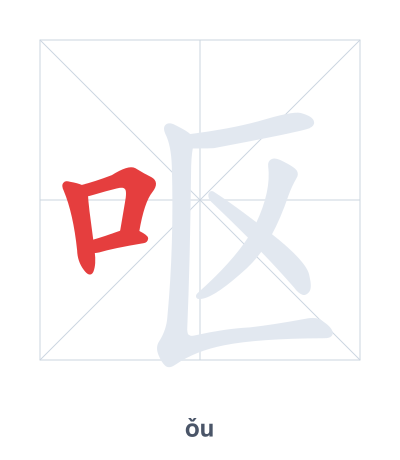
Open Hanzi Writer to see the animated stroke order and practice writing 呕 with real-time feedback.
The character 呕 (ǒu) is written with 7 strokes. Follow the standard Chinese stroke order: top to bottom, left to right, outside before inside. The radical 口 is one of its key components.
Practice the correct stroke order with the Hanzi Writer app to see animated stroke-by-stroke guidance with real-time feedback.
呕 means to vomit / to feel sick.
As an HSK Level 7 character, 呕 is an intermediate-level character.
呕 is a phono-semantic compound: the radical 口 (mouth) indicates the action of vomiting, while 区 (qū, 'area') provides the pronunciation 'ǒu'. The character suggests something expelled from the mouth into a region or container.
💡 Memory Tip: Picture a person opening their mouth (口) to vomit into a square-shaped bucket (区, like a container with three sides).
他觉得想呕吐。
tā jué de xiǎng ǒu tù
He feels like vomiting.
别跟他呕气了。
bié gēn tā ǒu qì le
Stop being angry with him.
这件事很呕心。
zhè jiàn shì hěn ǒu xīn
This matter is very disgusting.
Open Hanzi Writer to see the animated stroke order and practice writing 呕 with real-time feedback.
✨ Animated stroke order · Handwriting recognition · HSK-graded practice · Free to use
The left part, 口, is a radical meaning 'mouth,' which directly connects to the action of vomiting or feeling sick. The right part, 区, does not carry clear meaning but contributes to the pronunciation (ǒu, similar to qū). Together, the character shows an action done through the mouth.