㐆 (yǐn) means "Ancient character meaning to lean or rely on" in Chinese. It has 6 strokes with the radical ⺼.
Rated 3.2/5 in difficulty (challenging).
Appears in 3+ common words including 殷 (yīn), 殷勤 (yīn qín), 殷切 (yīn qiè).
Due to its 6 strokes, Hanzi Writer's error detection shows 㐆 requires focused practice — most learners need 10+ attempts for consistent accuracy.
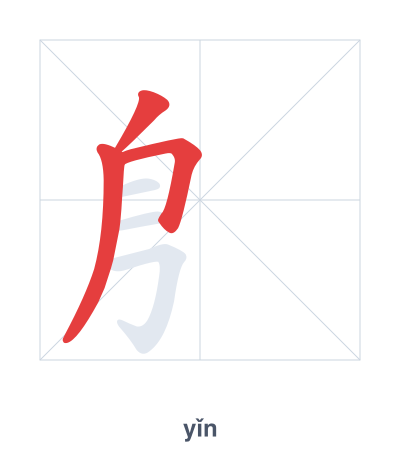
Open Hanzi Writer to see the animated stroke order and practice writing 㐆 with real-time feedback.
The character 㐆 (yǐn) is written with 6 strokes. Follow the standard Chinese stroke order: top to bottom, left to right, outside before inside. The radical ⺼ is one of its key components.
Practice the correct stroke order with the Hanzi Writer app to see animated stroke-by-stroke guidance with real-time feedback.
㐆 means Ancient character meaning to lean or rely on.
㐆 is an ancient pictograph showing a person turning or leaning backward, with a curved torso that visually represents the action of leaning or relying on something. Its form likely derived from a simplified figure bending to seek support.
💡 Memory Tip: Picture a person with a curved back leaning against a wall, their body forming the hook-like shape of 㐆.
殷老师在教中文。
yīn lǎo shī zài jiào zhōng wén 。
Teacher Yin is teaching Chinese.
他对客人很殷勤。
Tā duì kèrén hěn yīnqín.
He is very attentive to the guests.
父母有殷切的期望。
Fùmǔ yǒu yīnqiè de qīwàng.
Parents have earnest expectations.
Open Hanzi Writer to see the animated stroke order and practice writing 㐆 with real-time feedback.
✨ Animated stroke order · Handwriting recognition · HSK-graded practice · Free to use
㐆 consists of the radical ⺼ (flesh/meat) on the left and a curved line on the right. The meat radical suggests the body, and the curved line may represent leaning or bending, together hinting at the meaning 'to lean or rely on'.