Hanzi Writer

How to Write 乩 (jī) — Meaning “to practice divination”

6 strokes Radical: 乙

乩 (jī) means "to practice divination" in Chinese. It has 6 strokes with the radical 乙.

Rated 2.9/5 in difficulty (moderate).

Appears in 3+ common words including 乩童 (jī tóng), 扶乩 (fú jī), 占乩 (zhàn jī).

Hanzi Writer's stroke validation shows learners typically need 5-8 attempts to write 乩 with correct proportion and order.
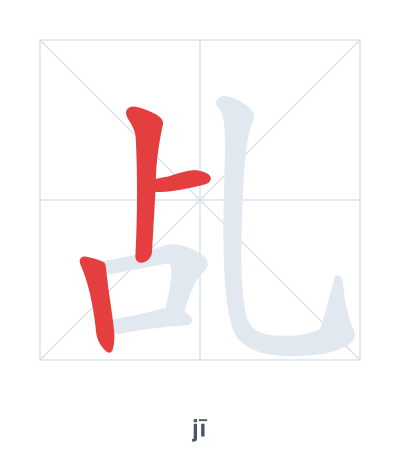
Stroke order practice for 乩 - jī

Practice Writing 乩 (jī)

Open Hanzi Writer to see the animated stroke order and practice writing 乩 with real-time feedback.

The character (jī) is written with 6 strokes. Follow the standard Chinese stroke order: top to bottom, left to right, outside before inside. The radical is one of its key components.

Practice the correct stroke order with the Hanzi Writer app to see animated stroke-by-stroke guidance with real-time feedback.

means to practice divination.

Character
Pinyinjī (ji)
Meaningto practice divination
Strokes6
Radical
Difficulty2.9/5

The character 乩 combines 占 (divination, 'to divine') with a curved stroke 乚 (a simplified form of 乙, suggesting a hook or stylus). This represents the act of using a planchette or rod to trace characters during divination rituals, where the curved line depicts the movement of the writing instrument.

💡 Memory Tip: Imagine a divination stick (乚) hooking onto a character 占 (divine) to pull out a fortune.

jī tóng
spirit medium or shaman
fú jī
planchette writing; divination using a sieve or tray
zhàn jī
divination using a planchette

庙里正在举行乩童仪式。

miào lǐ zhèng zài jǔ xíng jī tóng yí shì

A spirit medium ritual is being held in the temple.

扶乩是一种古老的习俗。

fú jī shì yī zhǒng gǔ lǎo de xí sú

Planchette writing is an ancient custom.

他去庙里请求占乩。

tā qù miào lǐ qǐng qiú zhàn jī

He went to the temple to seek a divination.

Character Pinyin Strokes Radical
(current) 6
5
8
8
Stroke order practice for 乩 - jī

Practice Writing 乩 (jī)

Open Hanzi Writer to see the animated stroke order and practice writing 乩 with real-time feedback.

✨ Animated stroke order · Handwriting recognition · HSK-graded practice · Free to use

Frequently Asked Questions about 乩

乩 consists of the radical 乙 (second, bent line) on the left and the component 占 (to occupy, to divine) on the right. The radical 乙 gives the character its shape, while 占 directly hints at its meaning of divination or fortune-telling.

Characters with Radical 乙

Other 6-Stroke Characters