叩 (kòu) means "To knock; to kowtow" in Chinese. It has 5 strokes with the radical 口.
Rated 2.9/5 in difficulty (moderate).
Appears in 3+ common words including 叩门 (kòu mén), 叩头 (kòu tóu), 叩谢 (kòu xiè).
Hanzi Writer's stroke validation shows learners typically need 5-8 attempts to write 叩 with correct proportion and order.
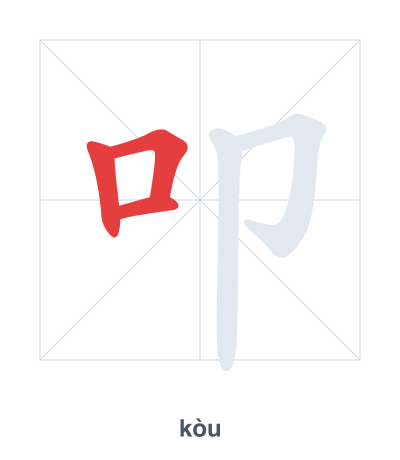
Open Hanzi Writer to see the animated stroke order and practice writing 叩 with real-time feedback.
The character 叩 (kòu) is written with 5 strokes. Follow the standard Chinese stroke order: top to bottom, left to right, outside before inside. The radical 口 is one of its key components.
Practice the correct stroke order with the Hanzi Writer app to see animated stroke-by-stroke guidance with real-time feedback.
叩 means To knock; to kowtow.
The character 叩 combines 口 (mouth) and 卩 (a kneeling person), originally depicting a person kneeling and bowing, with the mouth or head touching the ground, symbolizing the actions of knocking or kowtowing.
💡 Memory Tip: Imagine a kneeling person (卩) using their mouth (口) to knock on a door because their hands are tied.
有人在轻轻叩门。
yǒu rén zài qīng qīng kòu mén
Someone is knocking gently on the door.
他向长辈叩头行礼。
tā xiàng zhǎng bèi kòu tóu xíng lǐ
He kowtowed to his elders.
他叩谢救命之恩。
tā kòu xiè jiù mìng zhī ēn
He kowtowed in gratitude for saving his life.
Open Hanzi Writer to see the animated stroke order and practice writing 叩 with real-time feedback.
✨ Animated stroke order · Handwriting recognition · HSK-graded practice · Free to use
The left component is 口 (mouth), hinting at the sound of knocking. The right component is 卩 (a kneeling figure), representing the posture of kowtowing. Together they form the meanings of knocking and bowing deeply.