叨 (dāo/tāo) means "To chatter; to receive (honorific)" in Chinese. It has 5 strokes with the radical 口, and is HSK Level 7.
Rated 2.9/5 in difficulty (moderate).
Harder than 6% of HSK Level 7 characters.
Appears in 4+ common words including 叨念 (dāo niàn), 唠叨 (láo dāo), 叨扰 (tāo rǎo).
Hanzi Writer's stroke validation shows learners typically need 5-8 attempts to write 叨 with correct proportion and order.
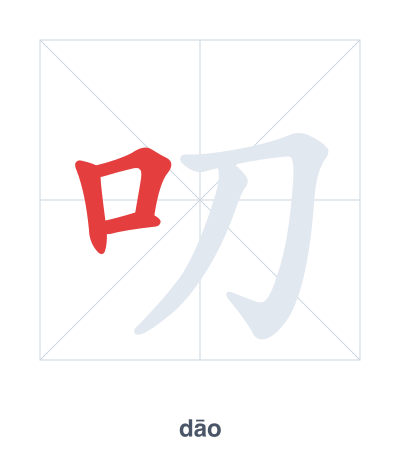
Open Hanzi Writer to see the animated stroke order and practice writing 叨 with real-time feedback.
The character 叨 (dāo/tāo) is written with 5 strokes. Follow the standard Chinese stroke order: top to bottom, left to right, outside before inside. The radical 口 is one of its key components.
Practice the correct stroke order with the Hanzi Writer app to see animated stroke-by-stroke guidance with real-time feedback.
叨 means To chatter; to receive (honorific).
This is a polyphonic character with readings: dāo, tāo.
As an HSK Level 7 character, 叨 is an intermediate-level character.
叨 combines 口 (mouth) and 刀 (knife), suggesting a sharp tongue that chatters incessantly. The character also acquired an honorific sense, possibly from extended use in polite phrases meaning 'to receive.'
💡 Memory Tip: Imagine a mouth (口) that keeps slicing like a knife (刀) — that's nonstop chattering.
奶奶总是念念不忘地叨念着远方的孙子。
nǎi nǎi zǒng shì niàn niàn bù wàng dì dāo niàn zhe yuǎn fāng de sūn zi
Grandma is always constantly talking about her grandson who is far away.
妈妈的唠叨虽然有些繁琐,但出发点都是为了我好。
mā mā de láo dāo suī rán yǒu xiē fán suǒ dàn chū fā diǎn dōu shì wèi le wǒ hǎo
Although Mom's nagging is a bit tedious, she does it with my best interests at heart.
承蒙招待,今天真是多有叨扰了。
chéng méng zhāo dài jīn tiān zhēn shì duō yǒu tāo rǎo le
Thank you for your hospitality; I've really imposed on you today.
这次能顺利完成任务,真是叨光了大家的帮助。
zhè cì néng shùn lì wán chéng rèn wù zhēn shì tāo guāng le dà jiā de bāng zhù
The successful completion of the task this time was really thanks to everyone's help.
Open Hanzi Writer to see the animated stroke order and practice writing 叨 with real-time feedback.
✨ Animated stroke order · Handwriting recognition · HSK-graded practice · Free to use
叨 is made of two parts: 口 (mouth) on the left and 刀 (knife) on the right. The mouth radical suggests speech, while the knife implies something sharp or repetitive. Together, they create the idea of talking in a sharp, repeating way — like chattering or nagging.