只 (zhī/zhǐ) means "Only; just; (measure word for animals/objects)" in Chinese. It has 5 strokes with the radical 口, and is HSK Level 2.
Rated 2.4/5 in difficulty (moderate).
Harder than 18% of HSK Level 2 characters.
Appears in 4+ common words including 只有 (zhǐ yǒu), 只要 (zhǐ yào), 一只 (yī zhī).
Hanzi Writer's stroke validation shows learners typically need 5-8 attempts to write 只 with correct proportion and order.
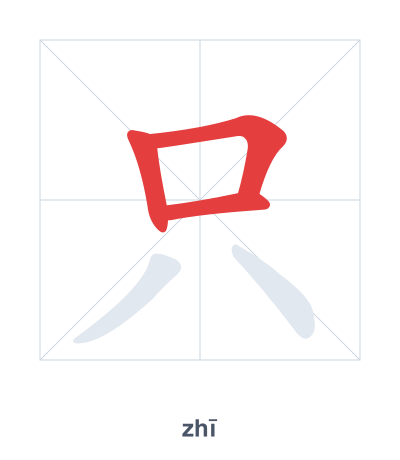
Open Hanzi Writer to see the animated stroke order and practice writing 只 with real-time feedback.
The character 只 (zhī/zhǐ) is written with 5 strokes. Follow the standard Chinese stroke order: top to bottom, left to right, outside before inside. The radical 口 is one of its key components.
Practice the correct stroke order with the Hanzi Writer app to see animated stroke-by-stroke guidance with real-time feedback.
只 means Only; just; (measure word for animals/objects).
This is a polyphonic character with readings: zhī, zhǐ.
As an HSK Level 2 character, 只 is among the first characters beginners learn.
只 combines 口 (mouth) and 八 (to divide), originally meaning a final particle that limits a statement; over time it took on the meanings 'only' and 'just' from the idea of partial or confined speech.
💡 Memory Tip: Picture a mouth (口) saying 'only two' while two legs (八) walk away, leaving just one behind.
只有通过不懈的努力,才能获得最后的成功。
zhǐ yǒu tōng guò bù xiè de nǔ lì cái néng huò dé zuì hòu de chéng gōng
Only through unremitting efforts can final success be achieved.
只要明天不下雨,我们就按计划去露营。
zhǐ yào míng tiān bù xià yǔ wǒ men jiù àn jì huà qù lù yíng
As long as it doesn't rain tomorrow, we will go camping as planned.
树枝上停着一只羽毛艳丽的小鸟。
shù zhī shàng tíng zhe yī zhī yǔ máo yàn lì de xiǎo niǎo
A bird with colorful feathers is perched on a tree branch.
他只身一人来到这座陌生的城市打拼。
tā zhī shēn yī rén lái dào zhè zuò mò shēng de chéng shì dǎ pīn
He came to this strange city all by himself to make a living.
Open Hanzi Writer to see the animated stroke order and practice writing 只 with real-time feedback.
✨ Animated stroke order · Handwriting recognition · HSK-graded practice · Free to use
只 has two parts: the radical 口 (mouth) on top and a bottom shape resembling 八 (eight). The mouth radical does not directly give the meaning 'only' or 'measure word' — this is a borrowed usage. Structurally, it's a top-bottom character.