丢 (diū) means "to lose; to throw" in Chinese. It has 6 strokes with the radical 一, and is HSK Level 5.
Rated 2.9/5 in difficulty (moderate).
Harder than 7% of HSK Level 5 characters.
Appears in 3+ common words including 丢了 (diū le), 丢脸 (diū liǎn), 丢掉 (diū diào).
Hanzi Writer's stroke validation shows learners typically need 5-8 attempts to write 丢 with correct proportion and order.
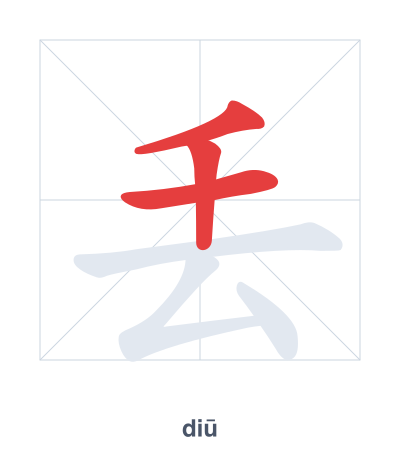
Open Hanzi Writer to see the animated stroke order and practice writing 丢 with real-time feedback.
The character 丢 (diū) is written with 6 strokes. Follow the standard Chinese stroke order: top to bottom, left to right, outside before inside. The radical 一 is one of its key components.
Practice the correct stroke order with the Hanzi Writer app to see animated stroke-by-stroke guidance with real-time feedback.
丢 means to lose; to throw.
As an HSK Level 5 character, 丢 is an intermediate-level character.
The character 丢 combines the radical 一 (one, representing an object) with 去 (to go), suggesting something going away or being lost. Its structure implies the action of casting something aside, leading to the meanings 'to lose' or 'to throw'.
💡 Memory Tip: Picture yourself throwing a single (一) ball that goes (去) over a fence—now you've lost it!
我的钱包丢了。
wǒ de qián bāo diū le
I lost my wallet.
这样做真的很丢脸。
zhè yàng zuò zhēn de hěn diū liǎn
Doing this is really embarrassing.
请把垃圾丢掉。
qǐng bǎ lā jī diū diào
Please throw away the trash.
Open Hanzi Writer to see the animated stroke order and practice writing 丢 with real-time feedback.
✨ Animated stroke order · Handwriting recognition · HSK-graded practice · Free to use
丢 is made of the radical 一 (one) on top and 去 (to go) below. The top stroke suggests an object, and 去 means 'to go away', so together they imply something that 'goes away' — you lose it or throw it away.