古 (gǔ) means "ancient" in Chinese. It has 5 strokes with the radical 口, and is HSK Level 3.
Rated 2.9/5 in difficulty (moderate).
Harder than 22% of HSK Level 3 characters.
Appears in 3+ common words including 古代 (gǔ dài), 古老 (gǔ lǎo), 古典 (gǔ diǎn).
Hanzi Writer's stroke validation shows learners typically need 5-8 attempts to write 古 with correct proportion and order.
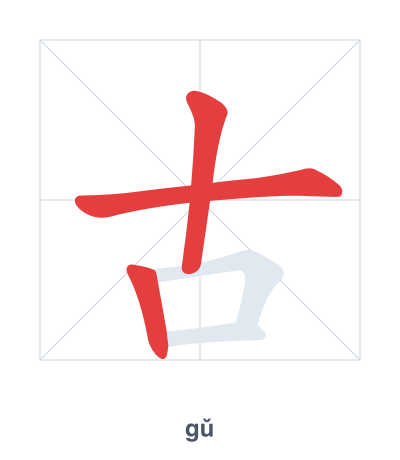
Open Hanzi Writer to see the animated stroke order and practice writing 古 with real-time feedback.
The character 古 (gǔ) is written with 5 strokes. Follow the standard Chinese stroke order: top to bottom, left to right, outside before inside. The radical 口 is one of its key components.
Practice the correct stroke order with the Hanzi Writer app to see animated stroke-by-stroke guidance with real-time feedback.
古 means ancient.
As an HSK Level 3 character, 古 is an intermediate-level character.
古 combines 十 (ten) and 口 (mouth), suggesting 'ten mouths' passing down stories through many generations, symbolizing ancient traditions. In oracle bone script, it depicted a shield (十) over a mouth, representing the protection of ancestral words.
💡 Memory Tip: Picture ten mouths (十 over 口) all chanting old stories together—that's ancient history itself.
他很喜欢研究古代历史。
tā hěn xǐ huān yán jiū gǔ dài lì shǐ
He likes studying ancient history.
这是一个古老的城市。
zhè shì yí gè gǔ lǎo de chéng shì
This is an ancient city.
我爱听古典音乐。
wǒ ài tīng gǔ diǎn yīn yuè
I love listening to classical music.
Open Hanzi Writer to see the animated stroke order and practice writing 古 with real-time feedback.
✨ Animated stroke order · Handwriting recognition · HSK-graded practice · Free to use
古 is made of 十 (ten) on top and 口 (mouth) below. This structure can be imagined as "ten mouths" sharing stories from long ago, so it means ancient.