另 (lìng) means "Another; other" in Chinese. It has 5 strokes with the radical 口, and is HSK Level 3.
Rated 2.9/5 in difficulty (moderate).
Harder than 22% of HSK Level 3 characters.
Appears in 3+ common words including 另外 (lìng wài), 另一个 (lìng yí gè), 另行 (lìng xíng).
Hanzi Writer's stroke validation shows learners typically need 5-8 attempts to write 另 with correct proportion and order.
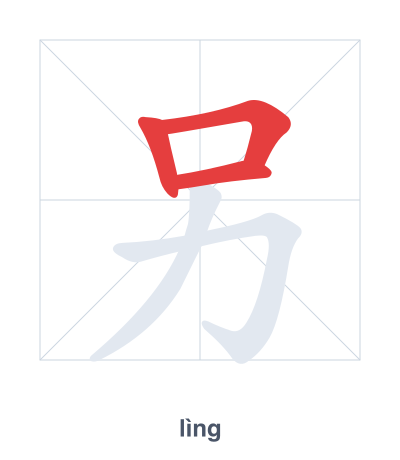
Open Hanzi Writer to see the animated stroke order and practice writing 另 with real-time feedback.
The character 另 (lìng) is written with 5 strokes. Follow the standard Chinese stroke order: top to bottom, left to right, outside before inside. The radical 口 is one of its key components.
Practice the correct stroke order with the Hanzi Writer app to see animated stroke-by-stroke guidance with real-time feedback.
另 means Another; other.
As an HSK Level 3 character, 另 is an intermediate-level character.
另 combines 口 (mouth) above and 力 (strength) below, suggesting a separate or additional force or command. Historically, it was used to indicate something distinct or alternative, like another option or person.
💡 Memory Tip: Picture a strong arm (力) pushing a mouth (口) aside to say 'another one, please!'
另外一个人是谁?
lìng wài yí gè rén shì shuí
Who is the other person?
请给我拿另一个杯子。
qǐng gěi wǒ ná lìng yí gè bēi zi
Please get me another cup.
会议时间将另行通知。
huì yì shí jiān jiāng lìng xíng tōng zhī
The meeting time will be notified separately.
Open Hanzi Writer to see the animated stroke order and practice writing 另 with real-time feedback.
✨ Animated stroke order · Handwriting recognition · HSK-graded practice · Free to use
另 is made of the radical 口 (mouth) on top and 力 (strength) on the bottom. The mouth suggests speaking or options, while strength implies action, together hinting at choosing "another" alternative.