口 (kǒu) means "mouth or opening" in Chinese. It has 3 strokes with the radical 口, and is HSK Level 1.
Rated 1.7/5 in difficulty (beginner-friendly).
Harder than 8% of HSK Level 1 characters.
Appears in 3+ common words including 门口 (mén kǒu), 一口气 (yì kǒu qì), 口语 (kǒu yǔ).
In the Hanzi Writer app, most learners master 口 within 3 practice attempts using stroke-by-stroke animation.
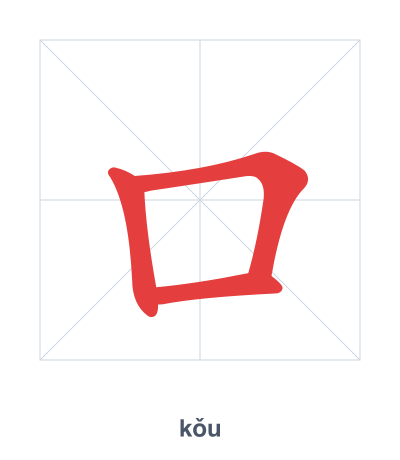
Open Hanzi Writer to see the animated stroke order and practice writing 口 with real-time feedback.
The character 口 (kǒu) is written with 3 strokes. Follow the standard Chinese stroke order: top to bottom, left to right, outside before inside. The radical 口 is one of its key components.
Practice the correct stroke order with the Hanzi Writer app to see animated stroke-by-stroke guidance with real-time feedback.
口 means mouth or opening.
As an HSK Level 1 character, 口 is among the first characters beginners learn.
口 is a pictograph of an open mouth. Its ancient form was a simple square or oval shape, directly depicting the opening of the mouth, which over time became the box-like shape we see today.
💡 Memory Tip: Imagine a square box that says 'O' like an open mouth waiting to eat or speak.
我在学校门口等你。
wǒ zài xué xiào mén kǒu děng nǐ
I am waiting for you at the school gate.
他一口气跑到了终点。
tā yì kǒu qì pǎo dào le zhōng diǎn
He ran to the finish line in one go.
他的汉语口语很好。
tā de hàn yǔ kǒu yǔ hěn hǎo
His spoken Chinese is very good.
Open Hanzi Writer to see the animated stroke order and practice writing 口 with real-time feedback.
✨ Animated stroke order · Handwriting recognition · HSK-graded practice · Free to use
口 is a simple square box that looks like an open mouth. It is both a radical and a complete character, and its shape directly represents its meaning: a mouth or an opening.