乓 (pāng) means "bang; thud (onomatopoeia)" in Chinese. It has 6 strokes with the radical 丿, and is HSK Level 7.
Rated 2.9/5 in difficulty (moderate).
Harder than 5% of HSK Level 7 characters.
Appears in 3+ common words including 乒乓球 (pīng pāng qiú), 乒乓 (pīng pāng), 乓的一声 (pāng de yī shēng).
Hanzi Writer's stroke validation shows learners typically need 5-8 attempts to write 乓 with correct proportion and order.
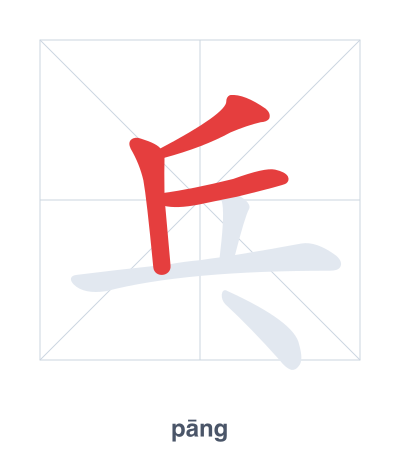
Open Hanzi Writer to see the animated stroke order and practice writing 乓 with real-time feedback.
The character 乓 (pāng) is written with 6 strokes. Follow the standard Chinese stroke order: top to bottom, left to right, outside before inside. The radical 丿 is one of its key components.
Practice the correct stroke order with the Hanzi Writer app to see animated stroke-by-stroke guidance with real-time feedback.
乓 means bang; thud (onomatopoeia).
As an HSK Level 7 character, 乓 is an intermediate-level character.
This onomatopoeic character is formed by modifying 兵 (soldier)—removing one stroke to suggest a sudden, forceful impact, like a bang or thud. It pairs with 乒 to mimic the sound of a ping-pong ball bouncing.
💡 Memory Tip: Picture a soldier (兵) tripping over a rock and falling flat with a loud 'pāng'—the missing stroke is his dropped weapon clattering away.
他乒乓球打得很好。
tā pīng pāng qiú dǎ dé hěn hǎo
He plays table tennis very well.
乒乓球在桌上跳。
pīng pāng qiú zài zhuō shàng tiào
The ping pong ball is bouncing on the table.
乓的一声,气球破了。
pāng de yī shēng qì qiú pò le
With a bang, the balloon popped.
Open Hanzi Writer to see the animated stroke order and practice writing 乓 with real-time feedback.
✨ Animated stroke order · Handwriting recognition · HSK-graded practice · Free to use
The character 乓 is composed of a left-falling stroke (丿) on top, with 八 (eight) below and a dot. The overall shape suggests a sudden burst or impact, matching its onomatopoeic meaning of "bang" or "thud."