卟 (bǔ) means "porphyrin (chemical term)" in Chinese. It has 5 strokes with the radical 口.
Rated 2.9/5 in difficulty (moderate).
Appears in 3+ common words including 卟吩 (bǔ fēn), 卟啉 (bǔ lín), 卟吩环 (bǔ fēn huán).
Hanzi Writer's stroke validation shows learners typically need 5-8 attempts to write 卟 with correct proportion and order.
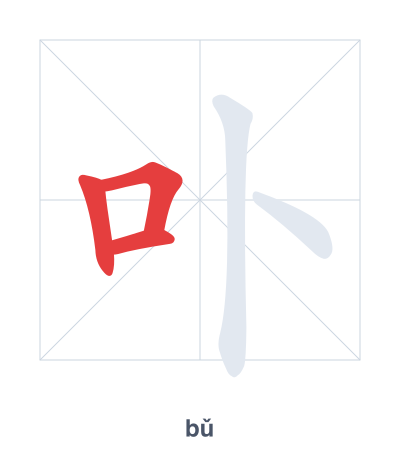
Open Hanzi Writer to see the animated stroke order and practice writing 卟 with real-time feedback.
The character 卟 (bǔ) is written with 5 strokes. Follow the standard Chinese stroke order: top to bottom, left to right, outside before inside. The radical 口 is one of its key components.
Practice the correct stroke order with the Hanzi Writer app to see animated stroke-by-stroke guidance with real-time feedback.
卟 means porphyrin (chemical term).
卟 is a modern character used in chemistry to transcribe 'porphyrin.' It combines the radical 口 (mouth) with the phonetic component 卜 (bǔ), which hints at the pronunciation. The shape itself does not depict porphyrin; its meaning is purely phonetic via transliteration.
💡 Memory Tip: Picture a mouth (口) saying 'bu' while holding a cross-shaped (卜) molecule—that's your porphyrin.
卟吩是一个化学名词。
bǔ fēn shì yí gè huà xué míng cí
Porphine is a chemical term.
血液中含有卟啉。
xuè yè zhōng hán yǒu bǔ lín
Blood contains porphyrins.
卟吩环的结构很稳定。
bǔ fēn huán de jié gòu hěn wěn dìng
The structure of the porphine ring is very stable.
Open Hanzi Writer to see the animated stroke order and practice writing 卟 with real-time feedback.
✨ Animated stroke order · Handwriting recognition · HSK-graded practice · Free to use
The character 卟 is formed by the radical 口 (mouth) on the left and the phonetic component 卜 (bǔ, divination) on the right. The left side indicates the character belongs to the mouth category, but here it is purely phonetic because 卟 is a transliteration character for chemical terms like porphyrin. Its meaning does not come from the components; instead, the combination is used to represent the sound "bǔ" in scientific words.