歉 (qiàn) means "apology; regret; deficient" in Chinese. It has 14 strokes with the radical 欠, and is HSK Level 6.
Rated 4.2/5 in difficulty (advanced).
Harder than 71% of HSK Level 6 characters.
Appears in 3+ common words including 道歉 (dào qiàn), 抱歉 (bào qiàn), 歉意 (qiàn yì).
Due to its 14 strokes, Hanzi Writer's error detection shows 歉 requires focused practice — most learners need 10+ attempts for consistent accuracy.
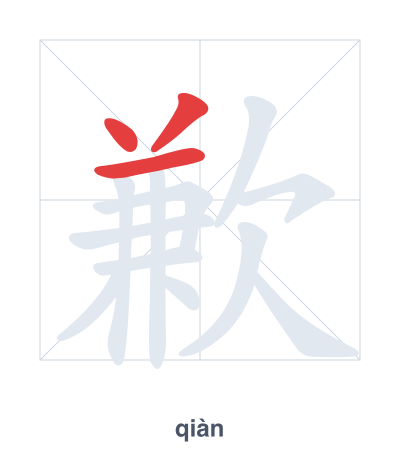
Open Hanzi Writer to see the animated stroke order and practice writing 歉 with real-time feedback.
The character 歉 (qiàn) is written with 14 strokes. Follow the standard Chinese stroke order: top to bottom, left to right, outside before inside. The radical 欠 is one of its key components.
Practice the correct stroke order with the Hanzi Writer app to see animated stroke-by-stroke guidance with real-time feedback.
歉 means apology; regret; deficient.
As an HSK Level 6 character, 歉 is an intermediate-level character.
This compound character combines 兼 (double) on the left and 欠 (lack) on the right. Originally meaning 'deficient' or 'insufficient,' the idea of lacking doubly—or failing to meet expectations—evolved into the modern senses of apology and regret.
💡 Memory Tip: Picture a double-bowed person (欠) making a deep, double apology (兼) for their deficiency.
我向你道歉。
wǒ xiàng nǐ dào qiàn
I apologize to you.
非常抱歉,我迟到了。
fēi cháng bào qiàn wǒ chí dào le
I am very sorry, I'm late.
请接受我的歉意。
qǐng jiē shòu wǒ de qiàn yì
Please accept my apologies.
Open Hanzi Writer to see the animated stroke order and practice writing 歉 with real-time feedback.
✨ Animated stroke order · Handwriting recognition · HSK-graded practice · Free to use
The character 歉 is composed of 兼 (meaning "double" or "both") on the left and 欠 (meaning "deficient" or "to owe") on the right. Together, they suggest being doubly deficient or lacking, which connects to feelings of apology or regret for a shortcoming.