欠 (qiàn) means "To owe / To lack" in Chinese. It has 4 strokes with the radical 欠, and is HSK Level 5.
Rated 2.4/5 in difficulty (moderate).
Harder than 3% of HSK Level 5 characters.
Appears in 3+ common words including 欠钱 (qiàn qián), 哈欠 (hā qiàn), 欠条 (qiàn tiáo).
Hanzi Writer's stroke validation shows learners typically need 5-8 attempts to write 欠 with correct proportion and order.
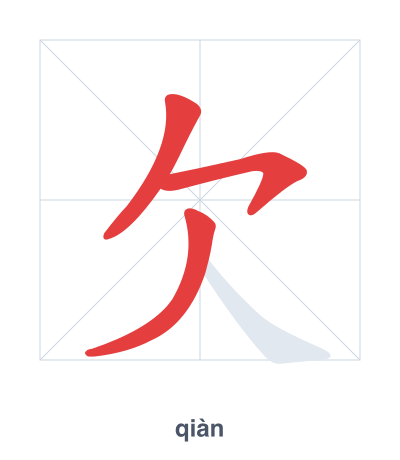
Open Hanzi Writer to see the animated stroke order and practice writing 欠 with real-time feedback.
The character 欠 (qiàn) is written with 4 strokes. Follow the standard Chinese stroke order: top to bottom, left to right, outside before inside. The radical 欠 is one of its key components.
Practice the correct stroke order with the Hanzi Writer app to see animated stroke-by-stroke guidance with real-time feedback.
欠 means To owe / To lack.
As an HSK Level 5 character, 欠 is an intermediate-level character.
欠 is a pictograph of a person with their mouth wide open, as if yawning or exhaling. The ancient form depicted a person bending forward, suggesting the act of breathing out or lacking breath, which evolved into the meanings 'to owe' or 'to lack'.
💡 Memory Tip: Picture a person yawning so hard their head tilts back, revealing they owe their body some sleep because they are lacking energy.
他因为欠钱不还,信用记录受到了很大的影响。
tā yīn wèi qiàn qián bù hái , xìn yòng jì lù shòu dào le hěn dà de yǐng xiǎng 。
Because he owed money and did not pay it back, his credit record was significantly affected.
他累得打了一个哈欠。
tā lèi dé dǎ le yí gè hā qiàn
He was so tired that he yawned.
他写了一张欠条给我。
tā xiě le yī zhāng qiàn tiáo gěi wǒ
He wrote me an IOU.
Open Hanzi Writer to see the animated stroke order and practice writing 欠 with real-time feedback.
✨ Animated stroke order · Handwriting recognition · HSK-graded practice · Free to use
欠 is a simple character depicting a person leaning forward with an open mouth, suggesting a lack of breath or energy. Its radical 欠 itself means "to owe" or "to lack," and it appears in characters related to breathing or deficiency.