疾 (jí) means "disease" in Chinese. It has 10 strokes with the radical 疒, and is HSK Level 6.
Rated 4.2/5 in difficulty (advanced).
Harder than 78% of HSK Level 6 characters.
Appears in 3+ common words including 疾病 (jí bìng), 疾走 (jí zǒu), 残疾 (cán jí).
Due to its 10 strokes, Hanzi Writer's error detection shows 疾 requires focused practice — most learners need 10+ attempts for consistent accuracy.
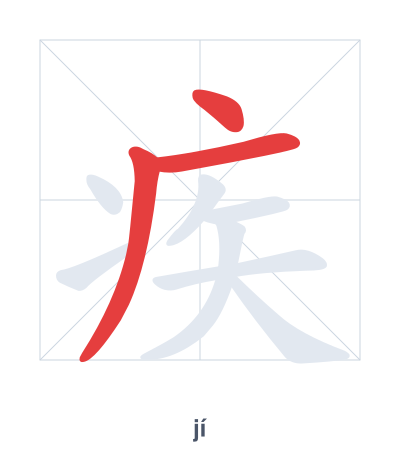
Open Hanzi Writer to see the animated stroke order and practice writing 疾 with real-time feedback.
The character 疾 (jí) is written with 10 strokes. Follow the standard Chinese stroke order: top to bottom, left to right, outside before inside. The radical 疒 is one of its key components.
Practice the correct stroke order with the Hanzi Writer app to see animated stroke-by-stroke guidance with real-time feedback.
疾 means disease.
As an HSK Level 6 character, 疾 is an intermediate-level character.
疾 combines the illness radical 疒 with 矢 (arrow), suggesting an ancient concept of disease as being struck by an arrow—a sudden, painful affliction. The original meaning was 'injury from an arrow,' which later generalized to any illness or disease.
💡 Memory Tip: Picture an arrow (矢) piercing a sickbed (疒), showing that disease feels like a sudden, sharp attack.
预防疾病很重要。
yù fáng jí bìng hěn zhòng yào
Preventing diseases is very important.
他在雨中疾走。
tā zài yǔ zhōng jí zǒu
He is walking fast in the rain.
我们要关爱残疾人。
wǒ men yào guān ài cán jí rén
We should care for people with disabilities.
Open Hanzi Writer to see the animated stroke order and practice writing 疾 with real-time feedback.
✨ Animated stroke order · Handwriting recognition · HSK-graded practice · Free to use
The character 疾 consists of the radical 疒 (illness) on the left and the component 矢 (arrow) on the right. The arrow suggests something sudden or fast, combining with the illness radical to imply a disease that strikes quickly. This structure reflects the meaning of 'disease' as well as the related sense of speed in words like 疾走 (to run fast).