欺 (qī) means "to deceive; to bully" in Chinese. It has 12 strokes with the radical 欠, and is HSK Level 6.
Rated 4.2/5 in difficulty (advanced).
Harder than 71% of HSK Level 6 characters.
Appears in 3+ common words including 欺负 (qī fù), 欺骗 (qī piàn), 欺诈 (qī zhà).
Due to its 12 strokes, Hanzi Writer's error detection shows 欺 requires focused practice — most learners need 10+ attempts for consistent accuracy.
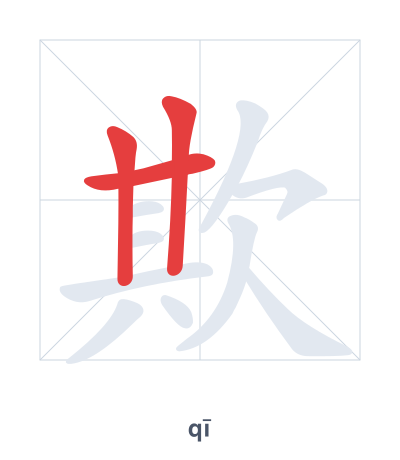
Open Hanzi Writer to see the animated stroke order and practice writing 欺 with real-time feedback.
The character 欺 (qī) is written with 12 strokes. Follow the standard Chinese stroke order: top to bottom, left to right, outside before inside. The radical 欠 is one of its key components.
Practice the correct stroke order with the Hanzi Writer app to see animated stroke-by-stroke guidance with real-time feedback.
欺 means to deceive; to bully.
As an HSK Level 6 character, 欺 is an intermediate-level character.
欺 is a compound character with the radical 欠 (deficiency or action of opening the mouth) and the phonetic component 其 (qí). The radical 欠 suggests an act involving the mouth, such as speaking or blowing, which connects to the meaning of deceiving through speech or taking advantage of someone's lack or weakness.
💡 Memory Tip: Picture a person (欠) yawning while telling a lie (其 sounds like 'cheat') to bully someone into believing them.
不要欺负小孩子。
bú yào qī fù xiǎo hái zi
Don't bully children.
他欺骗了我的朋友。
tā qī piàn le wǒ de péng yǒu
He deceived my friend.
这种行为属于欺诈。
zhè zhǒng xíng wéi shǔ yú qī zhà
This behavior constitutes fraud.
Open Hanzi Writer to see the animated stroke order and practice writing 欺 with real-time feedback.
✨ Animated stroke order · Handwriting recognition · HSK-graded practice · Free to use
欺 is made of two parts: the left side 其 (qí) provides a hint for pronunciation, and the right side 欠 (qiàn) means 'to lack' or 'to owe'. Together, they suggest that deception involves a lack of honesty or truth.