纳 (nà) means "to accept; to pay; to admit" in Chinese. It has 7 strokes with the radical 纟, and is HSK Level 6.
Rated 3.5/5 in difficulty (challenging).
Harder than 21% of HSK Level 6 characters.
Appears in 3+ common words including 缴纳 (jiǎo nà), 接纳 (jiē nà), 归纳 (guī nà).
Due to its 7 strokes, Hanzi Writer's error detection shows 纳 requires focused practice — most learners need 10+ attempts for consistent accuracy.
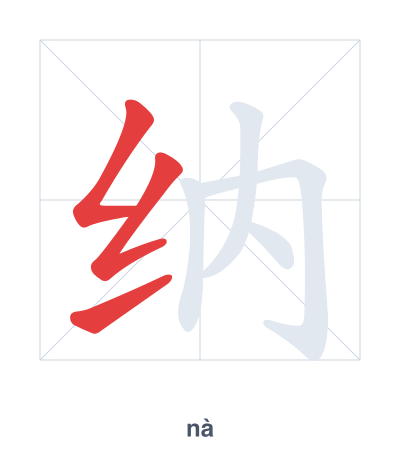
Open Hanzi Writer to see the animated stroke order and practice writing 纳 with real-time feedback.
The character 纳 (nà) is written with 7 strokes. Follow the standard Chinese stroke order: top to bottom, left to right, outside before inside. The radical 纟 is one of its key components.
Practice the correct stroke order with the Hanzi Writer app to see animated stroke-by-stroke guidance with real-time feedback.
纳 means to accept; to pay; to admit.
As an HSK Level 6 character, 纳 is an intermediate-level character.
纳 is a compound character with the silk radical 纟 and the phonetic component 内 (nèi, meaning 'inside'). Its original meaning relates to bringing silk inside, i.e., to take in or receive, which evolved into the senses of 'to accept', 'to pay', and 'to admit'.
💡 Memory Tip: Imagine a silk thread (纟) being pulled inside a box (内) to accept a payment.
请按时缴纳学费。
qǐng àn shí jiǎo nà xué fèi
Please pay your tuition on time.
大家都接纳了新同学。
dà jiā dōu jiē nà le xīn tóng xué
Everyone accepted the new classmate.
请归纳文章的大意。
qǐng guī nà wén zhāng de dà yì
Please summarize the main idea of the article.
Open Hanzi Writer to see the animated stroke order and practice writing 纳 with real-time feedback.
✨ Animated stroke order · Handwriting recognition · HSK-graded practice · Free to use
纳 is composed of the radical 纟 (silk thread) on the left and the phonetic component 内 (nèi, inside) on the right. The silk radical suggests a connection to binding or tying, while 内 hints at the idea of bringing something inward, which aligns with meanings like to accept or to pay.