暴 (bào) means "sudden; violent; cruel" in Chinese. It has 15 strokes with the radical 日, and is HSK Level 6.
Rated 4.2/5 in difficulty (advanced).
Harder than 68% of HSK Level 6 characters.
Appears in 3+ common words including 暴力 (bào lì), 暴雨 (bào yǔ), 暴露 (bào lù).
Due to its 15 strokes, Hanzi Writer's error detection shows 暴 requires focused practice — most learners need 10+ attempts for consistent accuracy.
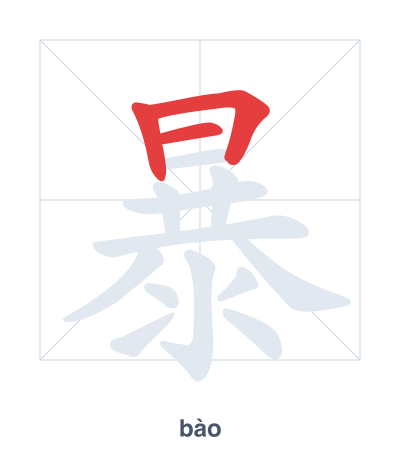
Open Hanzi Writer to see the animated stroke order and practice writing 暴 with real-time feedback.
The character 暴 (bào) is written with 15 strokes. Follow the standard Chinese stroke order: top to bottom, left to right, outside before inside. The radical 日 is one of its key components.
Practice the correct stroke order with the Hanzi Writer app to see animated stroke-by-stroke guidance with real-time feedback.
暴 means sudden; violent; cruel.
As an HSK Level 6 character, 暴 is an intermediate-level character.
Originally, 暴 depicted the sun (日) shining on grains held by two hands (廾), meaning 'to expose to the sun'. Over time, the meaning shifted to 'sudden' or 'violent', possibly from the idea of a sudden downpour or harsh sunlight. The modern form shows the sun above a container-like element (共) and two hands below.
💡 Memory Tip: Picture the sun (日) suddenly turning violent, smashing a container (共) and scattering the two hands (廾) apart.
我们反对暴力。
wǒ men fǎn duì bào lì
We oppose violence.
外面下起了暴雨。
wài miàn xià qǐ le bào yǔ
A rainstorm has started outside.
他的秘密暴露了。
tā de mì mì bào lù le
His secret was exposed.
Open Hanzi Writer to see the animated stroke order and practice writing 暴 with real-time feedback.
✨ Animated stroke order · Handwriting recognition · HSK-graded practice · Free to use
暴 combines 日 (sun/day) at the top with 共 (together) and 水 (water) at the bottom. The image suggests the sun (日) drying up water (水) together (共) — a "sudden" or "violent" change in weather, like an intense sun after rain.