欢 (huān) means "Happy / Joyous" in Chinese. It has 6 strokes with the radical 欠, and is HSK Level 1.
Rated 2.7/5 in difficulty (moderate).
Harder than 46% of HSK Level 1 characters.
Appears in 3+ common words including 喜欢 (xǐ huān), 欢迎 (huān yíng), 欢乐 (huān lè).
Hanzi Writer's stroke validation shows learners typically need 5-8 attempts to write 欢 with correct proportion and order.
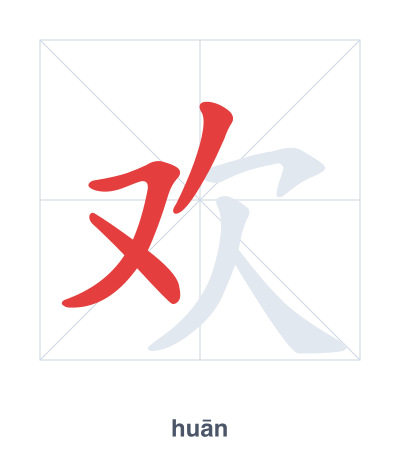
Open Hanzi Writer to see the animated stroke order and practice writing 欢 with real-time feedback.
The character 欢 (huān) is written with 6 strokes. Follow the standard Chinese stroke order: top to bottom, left to right, outside before inside. The radical 欠 is one of its key components.
Practice the correct stroke order with the Hanzi Writer app to see animated stroke-by-stroke guidance with real-time feedback.
欢 means Happy / Joyous.
As an HSK Level 1 character, 欢 is among the first characters beginners learn.
The simplified character 欢 combines 又 (hand, often indicating an action) and 欠 (an open mouth or yawn), together suggesting the act of cheering or laughing with hands raised in joy. Its traditional form 歡 originally depicted a heron's call (雚) with the mouth (欠), evoking a lively, happy sound.
💡 Memory Tip: Picture a person raising both hands (又) and letting out a joyous shout from an open mouth (欠) — pure celebration!
我喜欢喝茶。
wǒ xǐ huān hē chá
I like drinking tea.
欢迎你来我家。
huān yíng nǐ lái wǒ jiā
Welcome to my home.
大家过得很欢乐。
dà jiā guò dé hěn huān lè
Everyone had a very happy time.
Open Hanzi Writer to see the animated stroke order and practice writing 欢 with real-time feedback.
✨ Animated stroke order · Handwriting recognition · HSK-graded practice · Free to use
欢 is made of two parts: the left side 又 (meaning 'hand') and the right side 欠 (meaning 'to lack' or 'to yawn'). Together, they suggest someone so happy they wave their hand and open their mouth, which connects to the ideas of joy and excitement.