罢 (bà) means "To stop; to dismiss; to finish" in Chinese. It has 10 strokes with the radical 罒, and is HSK Level 6.
Rated 4.2/5 in difficulty (advanced).
Harder than 85% of HSK Level 6 characters.
Appears in 3+ common words including 罢工 (bà gōng), 罢课 (bà kè), 罢休 (bà xiū).
Due to its 10 strokes, Hanzi Writer's error detection shows 罢 requires focused practice — most learners need 10+ attempts for consistent accuracy.
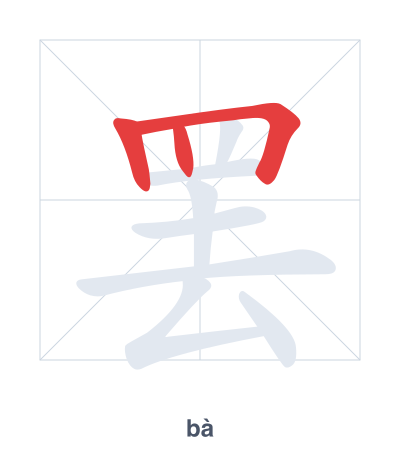
Open Hanzi Writer to see the animated stroke order and practice writing 罢 with real-time feedback.
The character 罢 (bà) is written with 10 strokes. Follow the standard Chinese stroke order: top to bottom, left to right, outside before inside. The radical 罒 is one of its key components.
Practice the correct stroke order with the Hanzi Writer app to see animated stroke-by-stroke guidance with real-time feedback.
罢 means To stop; to dismiss; to finish.
As an HSK Level 6 character, 罢 is an intermediate-level character.
The character 罢 combines a net (罒, a simplified form of 网) and to go (去), originally depicting releasing a trapped animal from a net—hence the meanings of stopping, dismissing, or finishing. In oracle bone script, the traditional form 罷 showed a net over a deer, symbolizing the end of a hunt.
💡 Memory Tip: Imagine a net (罒) catches you, but you go (去) away, so the hunt ends and you are dismissed.
他们决定罢工。
tā men jué dìng bà gōng
They decided to go on strike.
学生们罢课了。
xué shēng men bà kè le
The students are on strike.
他不会罢休的。
tā bú huì bà xiū de
He will not let it go.
Open Hanzi Writer to see the animated stroke order and practice writing 罢 with real-time feedback.
✨ Animated stroke order · Handwriting recognition · HSK-graded practice · Free to use
The character 罢 combines the radical 罒 (net) on top and 去 (to go) below. The net radical suggests covering or stopping, while 去 means to leave, together implying "to stop" or "to dismiss" something. This structure visually represents the idea of netting or trapping an action to bring it to an end.