次 (cì) means "Time / Order / Next" in Chinese. It has 6 strokes with the radical 欠, and is HSK Level 1.
Rated 2.7/5 in difficulty (moderate).
Harder than 46% of HSK Level 1 characters.
Appears in 3+ common words including 第一次 (dì yī cì), 几次 (jǐ cì), 下次 (xià cì).
Hanzi Writer's stroke validation shows learners typically need 5-8 attempts to write 次 with correct proportion and order.
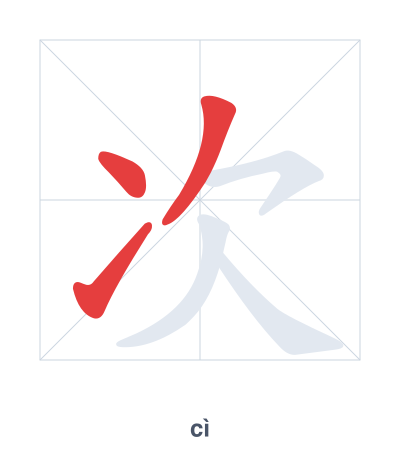
Open Hanzi Writer to see the animated stroke order and practice writing 次 with real-time feedback.
The character 次 (cì) is written with 6 strokes. Follow the standard Chinese stroke order: top to bottom, left to right, outside before inside. The radical 欠 is one of its key components.
Practice the correct stroke order with the Hanzi Writer app to see animated stroke-by-stroke guidance with real-time feedback.
次 means Time / Order / Next.
As an HSK Level 1 character, 次 is among the first characters beginners learn.
次 is a compound character combining 欠 (a person yawning or lacking) with 二 (two), originally suggesting something secondary or following after—like a 'second' yawn. Over time it evolved to mean 'order,' 'next,' or 'time' (as in occurrences).
💡 Memory Tip: A person (欠) yawns for the second time (二) — it's the 'next' yawn.
这是我第一次来北京。
zhè shì wǒ dì yī cì lái běi jīng
This is my first time in Beijing.
你去过几次中国?
nǐ qù guò jǐ cì zhōng guó
How many times have you been to China?
我们下次再见。
wǒ men xià cì zài jiàn
See you next time.
Open Hanzi Writer to see the animated stroke order and practice writing 次 with real-time feedback.
✨ Animated stroke order · Handwriting recognition · HSK-graded practice · Free to use
The character 次 has two parts: the left side '冫' (the ice radical) and the right side '欠' (meaning to lack or yawn). Together they originally suggested something inferior or secondary, which later led to its modern meanings of 'order', 'next', and as a measure word for times.